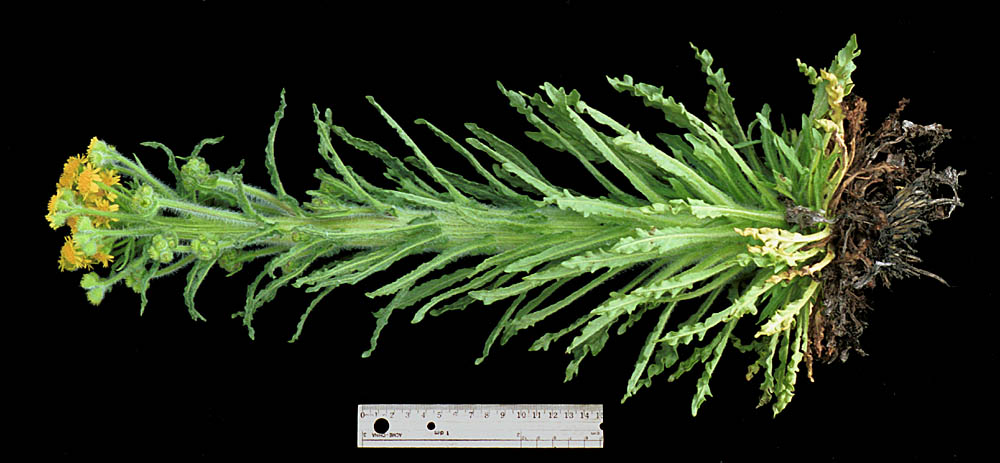
Senecio congestus

           
Marsh Ragwort

East of Glenavon on Highway # 48
11-June-2004

Note that the key to the species in Budd's Flora requires that the plant have a taproot.  The key in Flora of Alberta requires that there be NO branching rootstocks or basal tufts developed from a caudex.  In fact, the stem arises from a shortened, densely fibrous-rooted caudex as described in Flora of the Great Plains.

Note also that the key to the species in Flora of Alberta requires that the leaves be mostly entire or coarsely toothed; NOT mostly pinnatifid.  Yet the flora admits in the species description that the leaves may be shallowly pinnatifid.  The basal leaves in my specimen appear to be border-line pinnatifid.

Congestus:  Answers to key questions in Budd's Flora and Flora of Alberta leading to this species.  

native species of low ground; NOT introduced weed

annuals or biennials with taproots; NOT perennials with branching rootstocks or basal tufts developed from a caudex

stems stout; NOT slender

plants with few branches

more or less villose; NOT glabrous; NOT sparingly hairy

stems and leaves NOT glandular

leaves mostly entire or coarsely toothed; NOT mostly pinnatifid

flower heads few to many; NOT solitary

flower heads radiate; NOT discoid


Senecio: Answers to key questions in Budd's Flora and Flora of Alberta leading to this genus. 

leaves alternate; NOT opposite

involucral bracts uniseriate, equal, narrow, commonly with a few very much shorter outer ones at the base; NOT imbricate in two or more series; NOT broad and somewhat leafy

involucral bracts NOT imbricated

flower head with florets both tubular and ray

ray florets yellow; NOT blue, NOT purple, NOT white

stamens united to form a tube around the pistil

pappus composed of hairs; NOT composed of scales or bristles (Budd's Flora)

pappus simple, the bristles sometimes unequal, but NOT distinctly divided into two lengths; pappus NOT double, NO outer series that is inconspicuous and very much shorter than the inner (Flora of Alberta)