Atriplex hortensis
 
Garden Atriplex

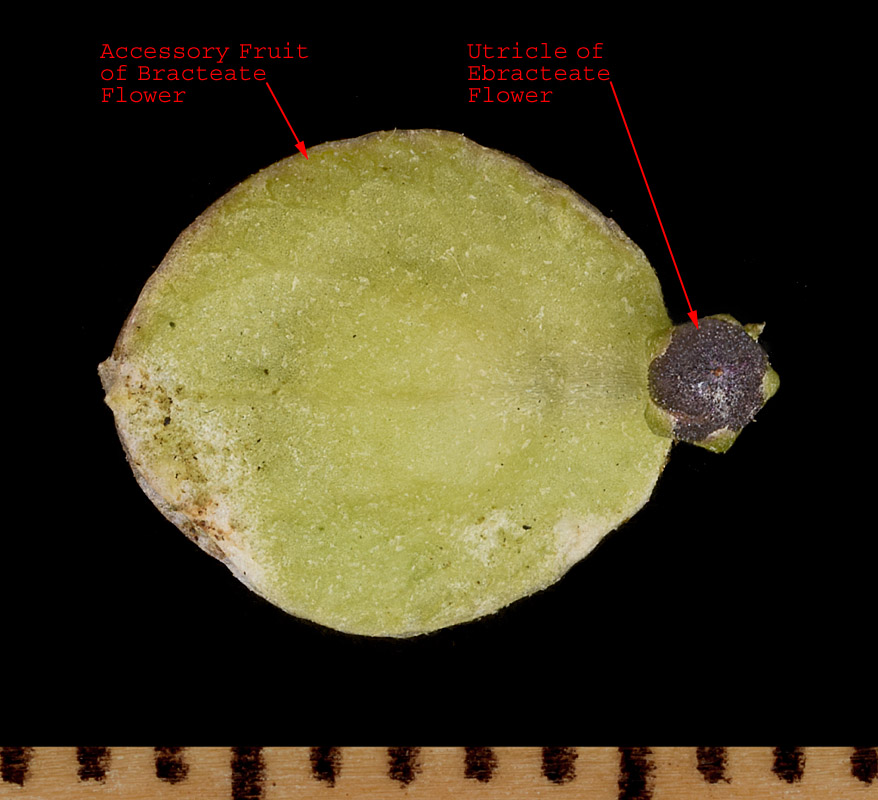
Fruit of Ebracteate and Bracteate Flowers

Regina
20-Aug-2018

This species has two types of pistillate flowers.  Flowers of the first type consist of an ovary enclosed within a 5-lobed calyx (each lobe is considered a sepal here).  After fertilization, this ovary will develop into a small, black, horizontally-aligned utricle.  Flowers of the second kind consist of an ovary enclosed within two bracteoles.  After fertilization, this ovary will develop into a small, brown, vertically-aligned utricle.  The structure composed of the two bracteoles plus the enclosed utricle can be viewed as an accessory fruit.  It is an accessory fruit because the bracteoles are not derived from the ovary.  In both cases, the pericarp of the utricle is thin, membranous, and easily removed from the interior seed.  As a result, the structure enclosed by the calyx or bracteoles is usually simply referred to as the seed.

A key to all the Atriplex species occurring in Saskatchewan is found here.  This key was derived from the key in the Flora of North America by removing all the non-Saskatchewan species.

Atriplex: Answers to key questions in Budd's Flora and Flora of Alberta leading to this genus. 

herbs or low shrubs

plants not spiny or prickly

plants with hyaline or white encrusting scales on stem and leaves; NOT [plants densely pubescent with yellowish brown stellate hairs]

stems not fleshy

stems not jointed

leaves alternate; NOT [leaves and branches opposite]

leaves not reduced to scales

petioles shorter than the lamina; NOT [petioles as long as and generally much longer than the lamina]

flowers not sunk into the stem

flowers not subtended by scarious bracts

plants monoecious or dioecious

staminate flowers without bracteoles but with a 3-5 lobed calyx; NOT [staminate flowers in catkin-like spikes, without a perianth, but subtended by peltate bracts]

sepals herbaceous or fleshy; NOT [sepals scarious]

pistillate flowers lacking a perianth but possessing a pair of bracteoles that enclose the ovary and enlarge in fruit

fruiting bract united, at least at base

fruiting bracts not covered with silvery, silky hairs

fruit not 2-toothed at apex

seed coat not winged at apex

seed coat leathery; NOT [seed coat membranous]


Amaranthaceae: Answers to key questions in Budd's Flora leading to this family.  Not all the answers apply to all the genera in Amaranthaceae, but they all do apply to Atriplex

herbs or occasionally low shrubs; NOT [shrubs or trees]

land plants; NOT [water plants]

plants not parasitic on trees, rooted in soil

plants not twining and climbing

plants without milky sap

plants monoecious or dioecious

flowers with only one floral ring, with sepals but not petals

pistillate flowers without calyx

stigmas 2; NOT [stigmas 1]

fruit not catkin-like; NOT [pistillate flowers and fruit in catkin-like spikes]

fruit enclosed in 2 bracteoles; NOT [fruit enclosed by 2-4 perianth segments]

NOT [fruit 3-seeded, splitting open at maturity]