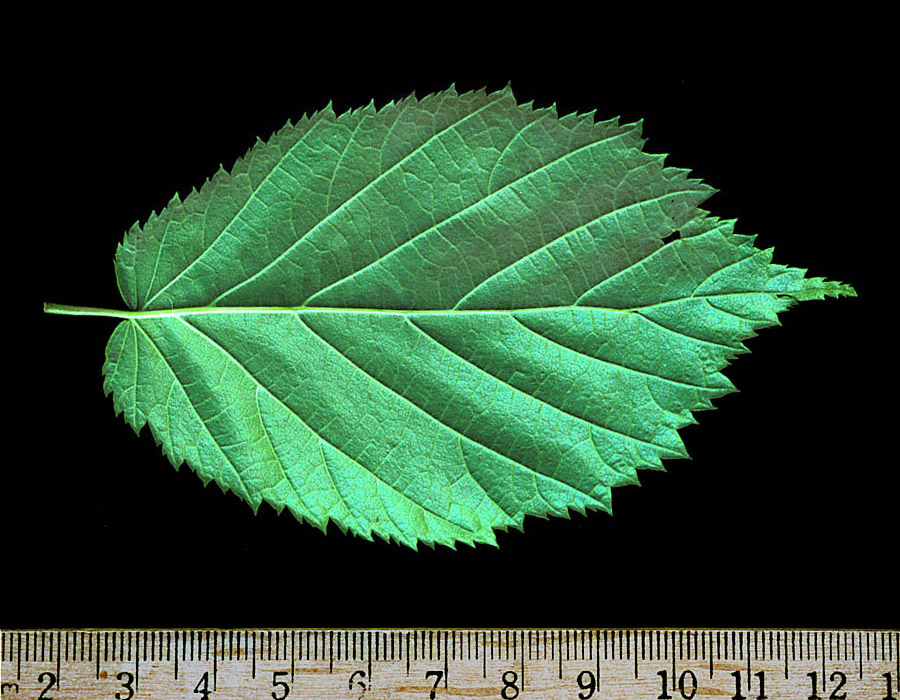
| Corylus: Answers
to key questions leading to this genus
 | Fruit
a nut over 1 cm long, enclosed in a tube-like involucre; bud scales and
bracts of staminate catkins with coarse, straight, appressed hairs;
pistillate catkins few-flowered and borne on short bud-like branches that
are distal to the staminate catkins and visible primarily as reddish
styles projecting from the bud at anthesis; NOT [Fruit a samara, much
shorter than 1 cm and subtended by a flat scale; bud scales and bracts
of staminate catkins not coarsely hairy; pistillate catkins
many-flowered, erect or pendulous, often borne on short shoots proximal
to the staminate catkins.]
|
|
| Betulaceae: Answers to key questions
leading to this family.
|
Plants monoecious or dioecious, fruits 1-seeded samaras,
nuts or drupes; NOT [Plants dioecious; fruits many-seeded capsules] |
|
Plants monoecious; fruits samaras or nuts lacking waxy
protuberances and persistent bracts and bracteoles; plant not aromatic;
leaf glands, if present, resinous and not as above; NOT [Plants usually
dioecious; fruit a nut or drupe, often covered with warty protuberances
with waxy coating or sometimes enclosed by persistent, accrescent bracts
and bracteoles; plants usually aromatic; leaves commonly with peltate,
multicellular, glandular trichomes] |
|
Fruits samaras or nuts, if nuts, then lacking a cupule
but sometimes subtended or enclosed by a foliaceous hull developed from
2-3 bracts; NOT [Fruits nuts surrounded or partly surrounded by a
cupule; this fruit is the acorn of oaks] |
|