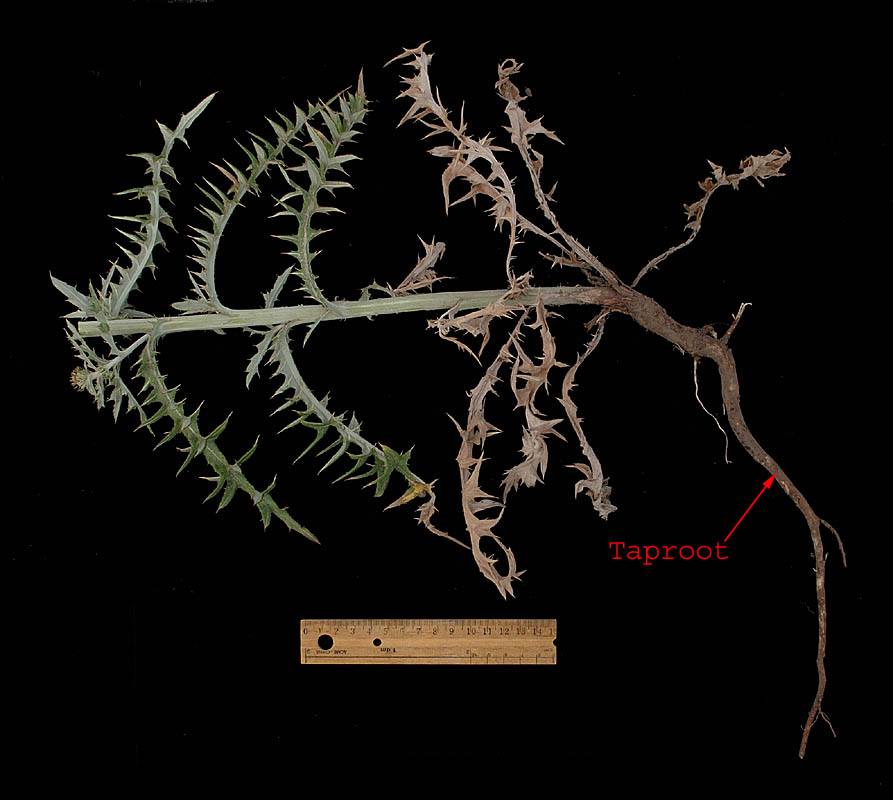
Cirsium undulatum
 
Wavy-Leaved Thistle

Lower Half of Plant

West Block, Cypress Hills Provincial Park
04-Aug-2006

The asexual aspect of the life cycle of this species is described by the Flora of the Great Plains as follows:

Perennial with a short, thick, deep subterranean taproot, sometimes reproducing by tuberous offsets.  Stems... propagating by shoots from usually deep subterranean taproots to form a perennial clone.

I find the key answers separating C. undulatum from C. flodmanii to be contradictory and not always correct.  Therefore, rather than trying to consolidate the answers from the different flora I have simply reprinted them verbatim.  The viewer can compare the answers with the pictures on this site and draw his/her own conclusions.  I find the best way to separate the two species is:

C. flodmanii occasionally has entire-margined lower leaves.  C. undulatum never does.  Thus the presence of entire margined leaves is sufficient to identify C. flodmanii, but the absence is inconclusive.

The achene of C. flodmanii is brown and has a well-defined yellow apical band about 0.5 mm wide, while the achene of C. undulatum is more straw coloured and does not have a well-defined apical band.  Compare the achenes of the two species on this web site.


Undulatum: Answers to key questions in Budd's Flora (BF) and Flora of Alberta (FOA) leading to this species.  Also included are just those answers from the species key in Flora of the Great Plains (FGP) which separate C. undulatum from C. flodmanii.   All the answers which separate C. undulatum from C. flodmanii are written on a white background.

biennial; NOT [perennial from deep roots] (BF)

plants WITHOUT creeping rootstocks; NOT [perennial plants from deep creeping root-stocks] (BF)

propagating by shoots from deep taproots; NOT [propagating by buds born on horizontal roots] (FGP)

plants always with stems (BF)

cauline leaves ovate to lanceolate; NOT [cauline leaves elliptic to oblanceolate] (FGP)

NO entire-margined leaves; NOT [occasionally some lower leaves entire-margined] (BF)

leaves pinnately divided or deeply cleft; NOT [leaves, upper ones at least, entire or only slightly lobed] (BF)

cauline leaves deeply pinnatifid lobed; NOT [cauline leaves subentire to shallowly lobed] (FOA)

cauline leaves mostly shallowly lobed to subentire; NOT [cauline leaves shallowly lobed to pinnatifid] (FGP)

leaf-lobes generally more than 7 mm wide; NOT [leaf-lobes generally less than 7 mm wide] (FOA)

leaves pale green or gray, somewhat woolly above; NOT [leaves deep green and bristly on upper sides] (BF)

upper surface of leaves NOT scabrous; NOT [upper surface of leaves scabrous with appressed spines] (FOA)

leaves white woolly beneath; NOT [leaves green on both sides when mature] (BF)

flowering Jun-Jul (Aug); NOT [flowering July-Sep] (FGP)

flower heads overtopping the foliage; NOT [flower heads exceeded by the foliage] (BF)

heads larger, more than 2.5 cm high; NOT [heads small, less than 2.5 cm high] (FOA)

heads smaller, less than 5 cm high; NOT [heads 5-7 cm high] (FOA)

involucres more than 2 cm high; NOT [involucres 1-2 cm high] (FOA)

involucres usually over 25 mm high; NOT [involucres rarely over 25 mm high] (BF)

involucres usually more than 12 mm wide; NOT [involucres rarely over 12 mm wide] (BF)

involucre NOT densely arachnoid; NOT [involucre densely arachnoid] (BF,FOA)

outer bracts more than 2 mm wide at base; NOT [outer bracts up to 2 mm wide at base] (FOA)

outer bracts progressively longer from outer to inner; NOT [outer bracts more or less equal] (FOA)

bracts with spiny tips; NOT [bracts usually without spiny tips] (BF)

outer bracts glandular; NOT [outer bracts eglandular] (FOA)

inner bracts of involucre WITHOUT loose, twisted, and spineless tips (BF)

male and female florets on the same plant or flower head; NOT [male and female flowers on separate plants] (BF)

corollas light purple; NOT [corollas deep purple (rarely white)] (FOA)

achenes more than 5 mm long; NOT [achenes up to 5 mm long] (FOA)

achenes 5-7 mm long; NOT [achenes 3-4(5) mm long] (FGP)

achenes 2-3 mm wide; NOT [achenes 1.5-2 mm wide] (FGP)

pappus of mature fruit shorter than corolla; NOT [pappus of mature fruit longer than corolla] (FOA)


Cirsium: Answers to key questions in Budd's Flora (BF) and Flora of Alberta (FOA) leading to this genus. 

juice watery; NOT [juice milky]

leaves with spiny margins

bracts of involucre NOT dry or parchmenty, usually green

some bracts spiny tipped; NOT [involucral bracts with hooked bristles]

receptacle densely bristly; NOT [receptacle naked]

flower heads with all florets tubular; NOT [flower heads with florets both tubular and ligulate]; NOT [flower heads with all florets ligulate]

stamens united to form a tube around the pistil

pappus of capillary bristles; NOT [pappus of scales, or of awns, or a crown or none]

pappus hairs much longer than achene

pappus bristles plumose; NOT [pappus bristles naked or merely minutely barbellate or merely roughened]