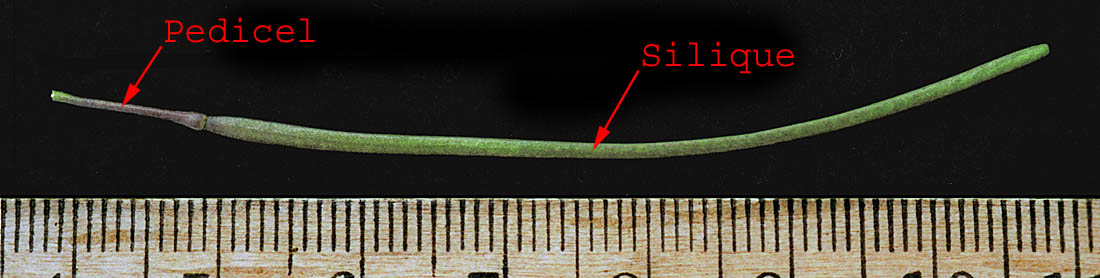
Arabis drummondii

 Drummond's Rock Cress

Silique

West Block, Cypress Hills
07-June-2005

Note that the key to the species in Flora of Alberta requires:

siliques generally more than 1.5 mm wide; NOT less than 1.5 mm wide

siliques 2-3 mm wide; NOT 1-2.5 mm wide

According to Flora of the Great Plains, the siliques are 1.5 to 2.3 mm wide.  However, this silique is 1.1 mm wide.  The rest of the answers to the key questions are listed below.

Drummondii:  Answers to key questions in Budd's Flora and Flora of Alberta leading to this species.  

plant slightly tufted; NOT [plant tufted]

plants mostly well over 3 dm tall; NOT [mostly under 2 dm tall]

pubescence (if any) of the lower stem simple to bifurcate, often appressed; NOT [pubescence of the lower stem often stellate to dendritic]]

basal leaves NOT lyrately lobed

basal leaves NOT felty

basal leaves with malpighian hairs; NOT [mostly with trifurcate to stellate or dendritic hairs]

stem leaves often clasping or eared

stem leaves with base auricled or sagittate; NOT [stem leaves sessile but not auricled nor sagittate]

stem leaves NOT coarsely hairy, the hairs, if any, 2- to 3-forked

siliques strictly erect

siliques flattened parallel to the partition; NOT [pods almost circular in cross section]

seeds biseriate; NOT [mostly uniseriate]

seeds winged, the wing mostly over 0.3 mm wide; NOT [seeds wingless or the wing less than 0.3 mm wide]

wing of seed nearly 1 mm wide; NOT [0.5 mm wide or less]


Arabis: Answers to key questions in Budd's Flora and Flora of Alberta leading to this genus.  These answers do not apply to all members of Arabis found in the Canadian prairies, but they do apply to this species.

plants pubescent, NOT glabrous

plants with pubescence mostly or entirely of branched hairs; NOT [plants glabrous, or the pubescence of simple hairs]

plants generally NOT glaucous

leaves more or less entire; NOT [deeply serrate to pinnate]

cauline leaves auriculate, clasping

flowers much smaller than 20-25 mm across

petals white, pink-tinged, pink or purple; NOT yellow

pods strongly flattened; NOT [terete or nearly so]

pods NOT compressed at right angles to the central partition

pods scarcely beaked; NOT with a long, distinct beak

pods usually at least 4 times longer than broad; NOT [2-3 times longer than broad or shorter]

central partition entire; NOT [with an opening sometimes almost reduced to the margin] 


Cruciferae: Answers to key questions in Budd's Flora leading to this family.

herbs; NOT [shrubs or trees]

plants terrestrial or semiaquatic; NOT [plants aquatic, leaves submerged or floating]

plants NOT with colored milky juice

plants with more than one normal leaf

some or all leaves alternate; NOT [leaves opposite, whorled, or basal]

leaves without stipules, or having glands; NOT [leaves with stipules]

flowers with two floral rings, and with each petal distinct from the others

calyx regular

sepals 4

corolla regular in shape

petals 4; NOT 5

stamens usually 6, four long and two short; NOT [stamens 6, of equal length]

carpels 1 or 2; NOT 3-5

ovary superior; NOT inferior