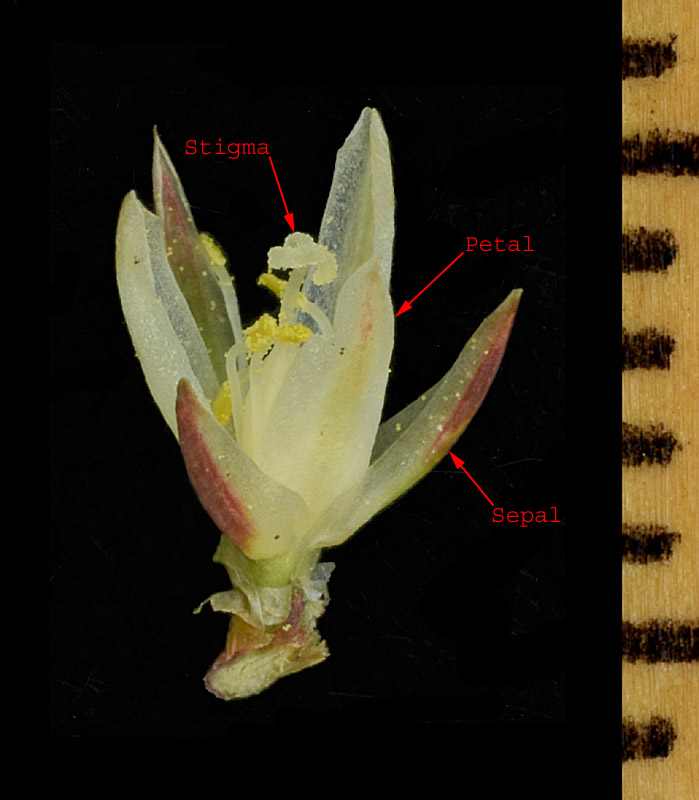
| Stygius: Answers
to key questions in Rushes, Bulrushes & Pondweeds plus the remaining
Monocots of Saskatchewan by V. L. Harms, A. L. Leighton, and M. A. Vetter
leading to this species. The answers are in the order you would
normally work through the key.
 |
Tepals not
subtended by a pair of bracteoles; flowers borne in tight clusters of 2
-100 (sometimes 1-flowered in Juncus stygius var. americanus),
these clusters (glomerules) subtended by small bracts; leaf blades
septate (in most species) or not. NOT [Tepals subtended by a pair
of floral bracteoles immediately below the flower; flowers borne singly
in the inflorescence either +/- evenly distributed or +/- grouped in
loose clusters (not in tight clusters, and if grouped in clusters
individual flowers and paired floral bracteoles are still visible and
not so tightly crowded such that individual flowers cannot be fairly
easily identified); leaf blades, if present, not septate.] |
|
Leaf
blades terete or +/-canaliculate or +/- flattened dorsiventrally (not
flattened laterally or equitant), usually < 3 mm wide. NOT
[Leaf blades flattened laterally (folded lengthwise), ensiform and
equitant, 1.5 - 6 mm wide.] |
|
Primary
bracts not distinctly white-scarious, may be somewhat but not broadly
inflated at base, apices obtuse to acute; tepals with margins narrower,
to one-third width of tepals, indistinct or membranous or scarious;
anthers much shorter to 2 times longer than filaments; styles of various
lengths; capsules variously locular with mucros to 0.5 mm (0.5 - 0.7 mm
in J. castaneus) or gradually tapering into long narrow beaks;
leaf blades terete or subterete (laterally flattened to subterete in J.
nevadensis) or canaliculate (J. castaneus, which is
recorded only from the ne corner of the province), septate or
indistinctly septate. NOT [Primary bracts distinctly
white-scarious and conspicuously inflated at the base, apices narrowly
attenuate to caudate; tepals with wide (>= one-third width of tepals)
scarious margins; anthers 2 - 3 times longer than filaments; styles 0.6
- 0.9 (1.2) mm long; capsules 3-locular with (0.5) 0.6 - 1.0 (1.1) mm
long mucros; leaf blades +/- canaliculate, not septate.] |
|
Plants
without the following combination of characteristics (but note that the
glomerules may be solitary or few). NOT [Glomerules solitary
(rarely 2), (1) 3 - 4 (5)-flowered; primary bracts about equal to
inflorescences in length; leaves all basal, blades 0.3 - 1 mm wide,
20-80 (100) mm long, with apices blunt, black and callose; anthers ca.
one-quarter filament length; plants 3-25 (35) cm high, recorded from
only 2 locations in northern boreal and subarctic transitional forest
regions.] |
|
Capsules
(5) 5.5 - 8.5 (9) mm long, long-exserted; seeds 2.4 - 3.5 mm long
including conspicuous 0.8 - 1.1 (1.6) mm long apicula; leaf blades
indistinctly septate; not found south of the boreal forest. NOT
[Capsules shorter, up to 5 mm long (except up to 5.7 mm long in Juncus
torreyi), included or exserted; seeds 0.4 - 1.2 mm long with very short
apicula; leaf blades mostly distinctly septate (septa externally
indistinct in Juncus mertensianus).] |
| Plants
cespitose, rhizomes short; sheaths with wide membranous margins; leaf
blades 0.4 - 0.8 mm wide; glomerules 1 - 3 flowered; sepals (3.5) 4- 5
mm long, lanceolate to lance-ovate, olive-green and red-tinged near
apices with 3-veined midribs; capsules 5.5- 7 (9) mm long,
pseudo-3-locular; anthers 0.3 - 0.5 mm long; rare to uncommon in
northern boreal and subarctic transitional forest regions. NOT
[Plants with elongate rhizomes with long internodes and few branches;
culms solitary at rhizome nodes; sheaths with narrow brownish membranous
margins; leaf blades (1) 1.5 - 4 mm wide; glomerules 2 - 10 flowered;
sepals 4.5 - 6.5 mm long, linear-lanceolate, dark to dark chestnut-brown
with prominent reddish brown midveins prolonged into awn-tips, capsules
(5) 6.5-8.5 mm long, 3-locular; anthers 0.6 - 1.3 mm long; recorded only
from the ne corner of the province.]
|
|
| Juncus: Answers
to key questions in Rushes, Bulrushes & Pondweeds plus the remaining
Monocots of Saskatchewan by V. L. Harms, A. L. Leighton, and M. A. Vetter
leading to this genus.
|
Leaves
various, glabrous; sheaths open, often with margins projected as
auricles; flowers with or without a pair of floral bracteoles
immediately below the tepals; capsules 1- or 3-locular (or pseudo- or
incompletely-3-locular), placentation axile or parietal; seeds many.
NOT [Leaves +/- flat and grass-like, sparsely to densely ciliate;
sheaths closed (or sometimes partially splitting later), auricles
absent; flowers with 1 - 2 floral bracteoles immediately below the
tepals; capsules 1-locular, placentation basal; seeds 3.] |
|