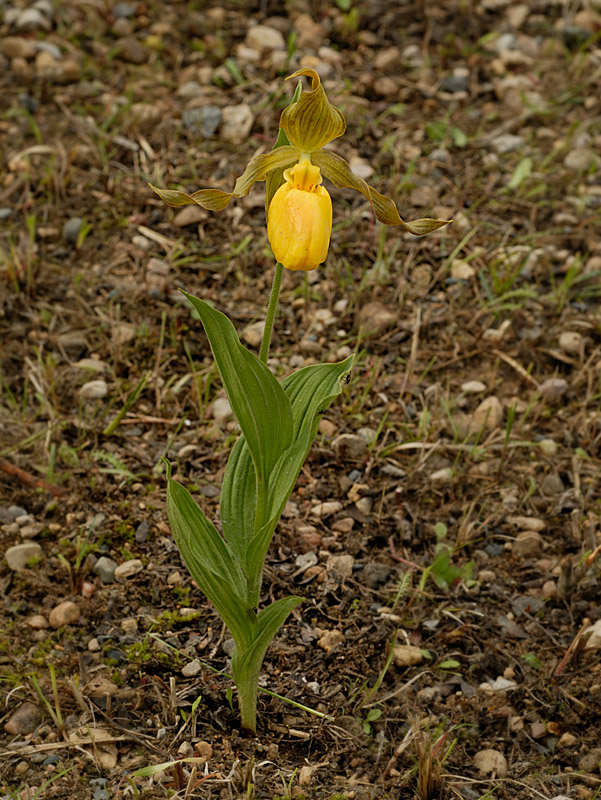
|
Parviflorum: Answers
to key questions in Lilies, Irises & Orchids of Saskatchewan by
Vernon L. Harms and Anna L. Leighton leading to this species. The
answers are in the order you would normally work through the key.
 |
Lateral
sepals united for nearly their full length (may be separate to near the
base in C. passerinum); lip obovoid to +/- spherical, sac-like, the tip
rounded, not cone-like or projecting downwards; NOT [Lateral sepals
separate, somewhat spreading; lip irregularly triangular in side view
with a cone-like, downward-projecting tip] |
|
Leaves 3
or more (occasionally 2 in C. parviflorum), cauline, alternate; lip less
bag-like and pendulous, with a rounded opening (orifice) and no
longitudinal fissure; yellow or white with various markings (variegated
white and pink in C. reginae); NOT [Leaves 2, basal; flowering stem
leafless; lip bag-like and pendulous, with a longitudinal fissure
extending the length of the pouch, rose-colored with conspicuous darker
reddish-purple vein-markings or blotches (or rarely white)] |
|
Lateral
petals usually +/- strongly twisted, distinctly longer than lip,
linear-lanceolate, with tips acute or acuminate, often long-attenuate;
plants with varying amounts of pubescence, +/- glandular; NOT [Lateral
petals flat, not twisted, about equal to or shorter than lip, elliptic
to ovate (or obovate), blunt-tipped to broadly acute; plants densely
hairy, glandular or not] |
|
Lip
yellow, with or without purple spots near the orifice; staminode
triangular, usually lobed or auriculate at base; NOT [Lip white, often
purple-veined or spotted externally or internally; staminode
oblong-lanceolate to narrowly ovate]
|
|
|
Cypripedium: Answers
to key questions in Lilies, Irises & Orchids of Saskatchewan by
Vernon L. Harms and Anna L. Leighton leading to this genus. The answers
are in the order you would normally work through the key.
|
Plants
green, with at least some green leaf-blades, these sometimes early
withering or late developing; flowering stems green (pale pink to
purplish-red in Calypso bulbosa), bearing sheathing bracts in some
species; rootstocks not coral-like; capsules spreading to erect
(occasionally drooping when old); NOT [Plants non-green saprophytes
lacking leaf-blades; flowering stems yellowish to purplish-red or brown
(pale greenish-yellow in C. trifid), bearing sheathing bracts; rhizomes
rootless, coral-like in their branching; capsules drooping] |
|
Flowers 1
to 2 per stalk (occasionally more in Cypripedium reginae and C.
montanum), large, showy; lip 1 cm long or longer, either inflated or
broad and flat; NOT [Flowers 3 or more in a spike-like inflorescence,
small, often inconspicuous; lip usually less than 1 cm long, but if
longer, neither inflated nor broad and flat] |
|
Lip
inflated, a slipper-like or sac-like pouch; flower subtended by a
single, large, usually leaf-shaped floral bract; leaves usually 2 or
more, present at flowering-time, (in Calypso bulbosa the broad, basal
leaf that is produced the previous fall, may or may not be present at
flowering time); NOT [Lip broad and flat, not inflated; flower subtended
by a pair of minute, scale-like floral bracts; leaf single, emerging
during or after flowering from upper sheathing bract on stem, linear,
grass-like, 2-4 mm wide, folded lengthwise] |
|
Leaves 2
or more, cauline or basal, lacking stalk-like bases, often folded
lengthwise; lip an inflated, nearly closed, sac-like pouch, lacking an
apron-like lamina; petal-like staminode present above stigma; stems
arising from rhizomes with slender roots; NOT [Leaf, when present,
single, basal, narrowed to a stalk-like base, not folded lengthwise; lip
slipper-like with a large opening and a broad "toe" covered
with a whitish, apron-like lamina; staminode absent; stems arising from
bulbous corms] |
|