Elymus curvatus
Short-Awned Wild-Rye
Single Node - Two Views
Duck Mountain Provincial Park
22-July-2025
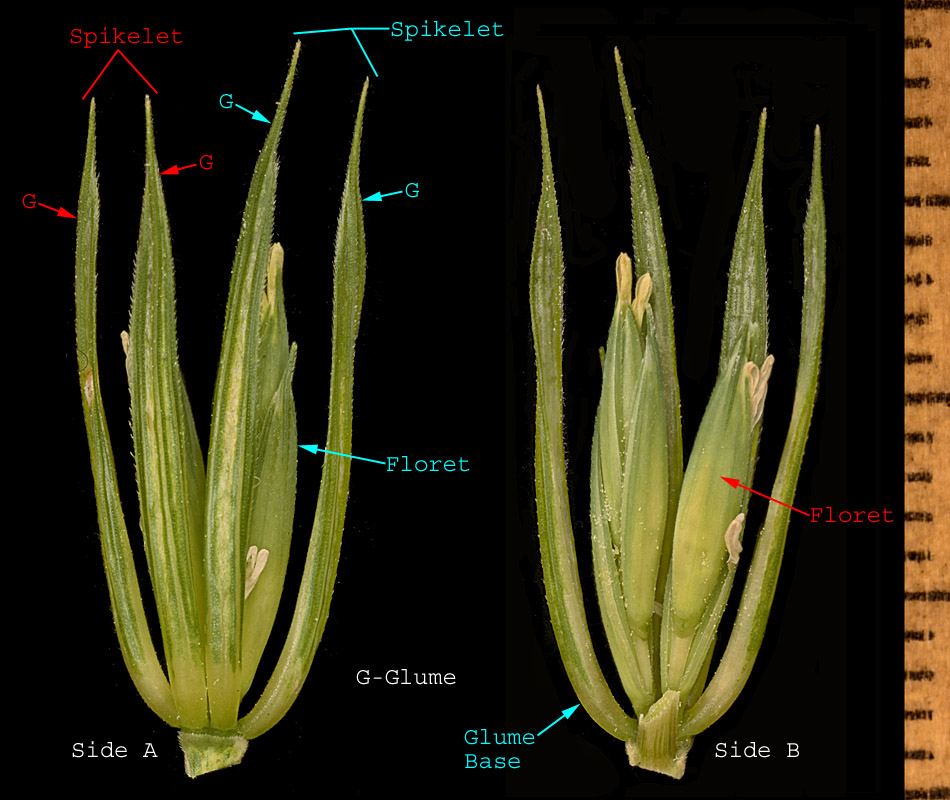
Two sides of the same node are pictured here. Note there are two spikelets per node. Turquoise
labels are used for components of one spikelet and red labels for components of
the other spikelet.
The glumes of this species are equal or
subequal. The glumes of E. diversiglumis are often distinctly
unequal in length.
The glumes of this species are 7-15 mm long with
awns an additional 3 (5) mm long. The glumes of E. diversiglumis can be
as short as (1) 2 mm long (including awn) but may be longer. The glume
awns of E. elymoides are 35 to 85 mm long. The glume awns of E.
canadensis are (5) 10-25 (27) mm long.
The glumes of this species are 1-2 mm wide. The
glumes of E. diversiglumis are 0.2-0.5 mm wide.
The glume bodies of this species equal or exceed
the lemma bodies. The glume bodies of E. canadensis are shorter
than or equal to the lemma bodies.
The glume bases of this species are not
overlapping and not evidently nerved. The glume bases of E. glaucous
are flat and often overlapping with evident nerves.
The glumes of this species are 1-3 nerved
distally. The glumes of E. diversiglumis are 0-1 nerved
distally.
The glume bases of this species are thickened to
terete for 2-3 mm. The glume bases of E. virginicus are thickened to
terete for just over 1 mm. The glume bases of E. canadensis are thickened
for at most 1 mm.
The glume bases of this species are bowed out. The glume bases of
E. canadensis are not bowed out.
The glumes of this species have firm
margins. The glumes of E. glaucous have hyaline margins.
The following items are taken from keys in Flora
of Saskatchewan, Fascicle 4, Grasses of Saskatchewan by Anna L. Leighton and
Vernon L. Harms. Family Poaceae is first divided into tribes, then the
tribes are divided into genera, and the genera divided into species.
However, there are a number of tribes that are very difficult to distinguish
morphologically. These are grouped into a large, artificial tribe I call
"Multitribe". Multitribe is then divided into groups, and each
group is then divided into genera. The answers are in the order you would
normally work through the keys.
 | Triticeae: Answers to key questions
leading to this tribe.
 | Mature inflorescence, if breaking into units, then the units not as
below; NOT [Mature inflorescence breaking into spikelet units consisting
of a sessile fertile spikelet, a hairy pedicel with or without a sterile
spikelet at tip, and a hairy rachis joint, all arising at the same point
(a node) in specialized panicle branches called rames] |
| Spikelets not as below; sterile florets if present, either located
distal to the fertile floret(s) on the rachilla or paired and attached
at the base of a single fertile floret, not paired with the upper glume
as below; lemma and palea variously textured, enclosing the flower or
not; disarticulation usually above the glumes; NOT [Spikelets usually
dorsally compressed, appearing 1-flowered but containing 1 fertile
floret and 1 sterile floret, the latter attached to the base of fertile
floret opposite the upper glume, resembling the upper glume, and
together with the upper glume enveloping the fertile floret; lower
glumes minute (sometimes absent) to 3/4 as long as upper glumes and
typically wrapping most of the way around the pedicel at base; fertile
floret seed-like with chartaceous-indurate lemma and palea enclosing
flower and fruit; disarticulation below the glumes with rare exceptions] |
| Spikelets 1 to many-flowered, subtended by a pair of glumes (only 1 on
lateral spikelets in Lolium); palea margins enclosed or not; plants of
dry or wet habitats; NOT [Spikelets 1-flowered, lacking glumes; margins
of the palea tightly enclosed by the lemma margins on female or perfect
florets; plants of wetlands, often emergent aquatic] |
| Inflorescence a terminal spike with sessile or subsessile spikelets
attached broadside at nodes on opposite sides of the rachis; NOT
[Inflorescence not as above; if a terminal spike, then the lateral
spikelets attached edgewise to the rachis with inner (upper) glume
wanting (as in Lolium)]
|
|
| Elymus: Answers to key questions
leading to this genus. Not all the answers apply to all members of Elymus,
but they all do apply to a subset containing E. diversiglumis).
| Curvatus: Answers to key questions
leading to this species.
| Spikelets 2 or more per node (occasionally 1 at some nodes); glumes
setaceous to linear-lanceolate; NOT [Spikelets 1 per node (occasionally
2 at some nodes); glumes lanceolate or wider (except E. glaucus
which may have linear-lanceolate glumes)] |
| Rachis not disarticulating at the nodes at maturity; glume awns if
long and outcurving then not forking near base; NOT [Rachis
disarticulating at the nodes at maturity; glume awns 35-85 mm long,
flexuous or outcurving, often forking into 2-3 divisions near the base] |
| Glumes usually setaceous or linear-lanceolate, with firm margins;
glume bases thickened to terete, not overlapping, lacking apparent
nerves; NOT [Glumes linear-lanceolate to lanceolate, with hyaline
margins; glume bases flat, often overlapping, nerved to near base] |
| Glumes
subsetaceous to linear-lanceolate, 1-5 (7)-nerved distally, 0.5-2 mm
wide, 11-40 mm long (entire length including awns); if shorter then
bowed out at base, and equal or subequal; NOT [Glumes setaceous, 0.2-0.5 mm wide, 0-1-nerved distally, (1) 2-15 (20)
mm long (entire length to tip), 1 or both less than 12 mm long, often
distinctly unequal in length with 1 glume of a pair usually several mm
shorter than the other, and occasionally obsolete] |
| Lowest lemma of spikelets at mid-culm 6-10 mm long; lemma awns
straight; glume bodies equaling or exceeding the lemma bodies; glumes
awns at most 10 (15) mm long, straight; glume bases thickened to terete
and indurate for just over 1 mm to 3 mm, bowed out; NOT [Lowest lemma of
spikelets at mid-culm 8-15 mm long; lemma awns outcurving; glume bodies
shorter than or equaling the lemma bodies; glume awns (5) 10-25 (27) mm
long, straight or outcurving; glume bases thickened and indurate for at
most 1 mm, not bowed out] |
| Lemma awns 1-3 (4) mm long; glume bases thickened to terete for 2-3 mm;
NOT [Lemma awns (5) 8-20 (25) mm long; glume bases thickened to terete
for just over 1 mm]
|
|
|