| Multitribe: Answers to key questions
leading to this tribe.
 | Mature inflorescence, if breaking into units, then the units not as
below; NOT [Mature inflorescence breaking into spikelet units consisting
of a sessile fertile spikelet, a hairy pedicel with or without a sterile
spikelet at tip, and a hairy rachis joint, all arising at the same point
(a node) in specialized panicle branches called rames] |
| Spikelets not as below; sterile florets if present, either located
distal to the fertile floret(s) on the rachilla or paired and attached
at the base of a single fertile floret, not paired with the upper glume
as below; lemma and palea variously textured, enclosing the flower or
not; disarticulation usually above the glumes; NOT [Spikelets usually
dorsally compressed, appearing 1-flowered but containing 1 fertile
floret and 1 sterile floret, the latter attached to the base of fertile
floret opposite the upper glume, resembling the upper glume, and
together with the upper glume enveloping the fertile floret; lower
glumes minute (sometimes absent) to 3/4 as long as upper glumes and
typically wrapping most of the way around the pedicel at base; fertile
floret seed-like with chartaceous-indurate lemma and palea enclosing
flower and fruit; disarticulation below the glumes with rare exceptions] |
| Spikelets 1 to many-flowered, subtended by a pair of glumes (only 1 on
lateral spikelets in Lolium); palea margins enclosed or not; plants of
dry or wet habitats; NOT [Spikelets 1-flowered, lacking glumes; margins
of the palea tightly enclosed by the lemma margins on female or perfect
florets; plants of wetlands, often emergent aquatic] |
| Inflorescence not as below; if a terminal spike, then the lateral
spikelets attached edgewise to the rachis with inner (upper) glume
wanting (as in Lolium); NOT [Inflorescence a terminal spike with sessile
or subsessile spikelets attached broadside at nodes on opposite sides of
the rachis] |
| Lemmas and lemma awns not as below; if lemma indurate and enveloping
the floret, then glumes distinctly dorsally compressed and calluses
glabrous (as in Milium); NOT [Lemmas stiff to indurate, firmer than the
glumes, surrounding the palea and often overlapping along the margins,
closed at the tip as well as at the base, often pubescent; lemma awns
(caducous or wanting in some species) terete and encircled at the base
by the closed tip of the lemma; calluses usually pubescent, rarely
glabrous]
|
|
| Group2: Answers to key questions
leading to this group.
| If plants mat-forming, then inflorescences not as below; NOT
[Mat-forming annuals or perennials either with clusters of spikelets
hidden by sharp-pointed leaves at branch tips, or with pistillate
inflorescences consisting of burs partially hidden within expanded leaf
sheaths with only the staminate inflorescences exceeding the upper
leaves] |
| Inflorescence not as below, the spikelets usually on pedicels in
panicles that range from spike-like to open; if spikelets sessile, then
they either have more than 1 fertile floret per spikelet or are not
arranged like the teeth of a comb; NOT [Inflorescence consisting of
spike-like panicle branches with sessile- subsessile, closely imbricate,
regularly-spaced, parallel spikelets all directed toward 1 side of the
branch like the teeth of a comb (loosely so in Bouteloua curtipendula);
fertile florets 1 per spikelet] |
| Spikelets with 1 fertile floret; sterile florets if present, attached
above or below the fertile floret; NOT [Spikelets with more than 1
fertile floret; sterile florets if present, attached above the fertile
florets (Phragmites, with sterile florets attached above and below
fertile florets, is an exception)]
|
| Muhlenbergia: Answers to key questions
leading to this genus.
| Spikelets pedicellate; inflorescence not as below; NOT [Spikelets
sessile and closely oppressed to slender, 3-sided branches;
inflorescence usually comprising over 1/2 of the plant height] |
| Sterile florets, when present, attached to the rachilla distal to the
fertile floret; NOT [Sterile florets 2, attached at base of the fertile
floret, either rudimentary and lacking sexual parts, or large and
staminate] |
| Panicles contracted to open; if spike-like, then disarticulation above
the glumes; calluses glabrous or bearded;
NOT [Panicles spike-like, dense, uninterrupted; disarticulation
below the glumes (occasionally above the glumes early in the season for
Phleum species) with spikelets at the top of the rachis falling and
revealing the naked rachis in mature plants; calluses glabrous] |
| Calluses glabrous or bearded with sparse hairs < 1 mm long; if
callus hairs longer than 1 mm, then lemmas pubescent proximally with
hairs similar in length to the callus hairs, and lemma awns, if present,
attached at or just below the apex; NOT [Calluses densely to sparsely
bearded with hairs 1-4.5 mm long; lemmas glabrous or rarely
scabridulous-puberulent; lemma awns absent or attached to the lemma back
usually below midlength] |
| Spikelets not dorsally compressed, glumes usually 1-nerved; lemma not
as below; NOT [Spikelets dorsally compressed; glumes 3-nerved; lemmas
unawned, thicker and harder than glumes, indurate, the involute margins
partially enclosing the indurate palea and forming a shiny, seed-like
unit at maturity] |
| Paleas ? the same length as lemmas; if paleas hyaline and as short as
3/4 lemma length, then lemmas awned from just below tip or paleas
distinctly appearing 1-nerved; NOT [Paleas absent, minute or at most 3/4
the length of lemmas, thin, hyaline; lemmas thin-textured, membranous to
hyaline, unawned or awned from the back] |
| Plants perennial with open, contracted or spike-like panicles, or
annual with panicles included in inflated sheaths; lemmas unawned or
awned, if awns subterminal, then short (to 2.5 mm) and glumes subequal;
NOT [Plants annual with contracted panicles; lemmas with subterminal
awns (4) 8-10 (15) mm long; glumes unequal] |
| Leaf blades <= 6 mm wide; ligules, if membranous then <= 3 mm
long and not brownish; glumes sometimes scabridulous-scabrous distally;
paleas 2-nerved; panicle spike-like, contracted or open, if open then
not as below; NOT [Leaf blades 4-12 (20) mm wide; ligules membranous,
2-7 (10) mm long, brownish; glume keels scabrous to ciliate with short
stiff hairs; paleas 1-nerved or appearing 1-nerved; panicles open,
usually 20-30 cm long, lax, often nodding] |
| Glumes equal to subequal; ligules membranous, to 3 mm long; lemmas
usually mucronate or awned; if not, then panicle diffuse with a single
minute spikelet at the tip of each hair-like branch; paleas similar size
or narrower than the lemmas; leaf sheaths hyaline at summit; fruit a
narrow, elongate caryopsis; NOT [Glumes subequal to unequal; ligules
consisting of hairs <= 1 mm long; lemmas acute, not mucronate or
awned; paleas as wide or wider than the lemmas, in some species
enveloping the flower and splitting ventrally to release the ripe fruit;
leaf sheaths often with tufts of hair at summit; fruit an ellipsoidal to
globose utricle or achene]
|
|
| Glomerata: Answers to key questions
leading to this species
| Panicles
contracted or spike-like at maturity, 0.1-3 cm wide with appressed to
ascending branches; spikelets (1.5) 1.7-8 mm long on pedicels usually
shorter than the spikelets or not much longer; NOT [Panicles diffuse at
maturity, 4-16 cm wide with spreading branches; spikelets 1-2 mm long on
long, slender pedicels] |
| If
present, callus hairs and hairs at base of the lemma <= 1.2 mm long
and shorter than the lemma; NOT [Callus hairs and hairs at base of the
lemma 2-3.5 mm long and as long as the lemma] |
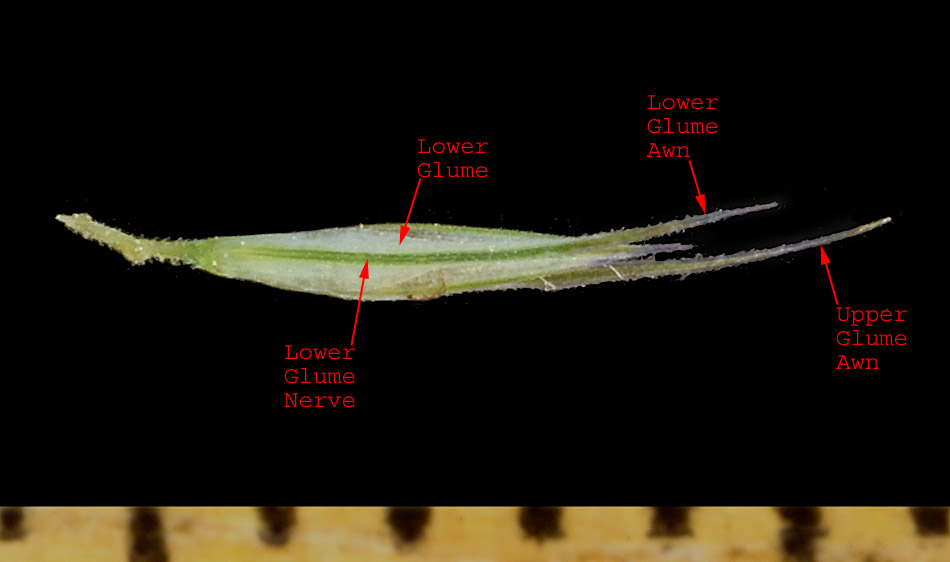
| Glumes
(including awn) slightly shorter or distinctly longer than the lemma;
lemmas pubescent proximally with hairs to 1.2 mm long; rhizomes present,
creeping, 1-2 mm wide, scaly; NOT [Glumes at most 3/4 as long as the
lemma; lemmas glabrous or short pubescent proximally with hairs < 0.7
mm long; rhizomes, if present, then slender and lacking scales] |
| Glumes
(including awns) 3-8 mm long, distinctly longer than the lemma; lemma
hairs up to 1.2 mm long; NOT [Glumes (including awns) 1.5-3.7 mm long,
<= the lemma; lemma hairs up to 0.7 mm long] |
| Culms unbranched or
branched from near base, terete; internodes puberulent to minutely
roughened (rough to the touch) from summit to base or part way down from
summit; leaf sheaths with visible midvein but not keeled; lemmas fairly
densely pilose, ? uniformly green or plumbeous; ligule 0.2-0.6 mm long;
anthers 0.8-1.5 mm long; caryopses to 1.6 mm long, oblong-cylindrical;
NOT [Culms unbranched or branched from middle nodes, elliptic in
cross-section; internodes smooth (smooth to the touch) except near
summit where they may be puberulent; leaf sheaths somewhat keeled with a
prominent midvein; lemma relatively sparsely pilose, often pale with
dark green or plumbeous blotches; ligule 0.6-1.5 (1.7) mm long; anthers
0.4-0.8 mm long; caryopses to 2.3 mm long, linear-cylindrical]
|
|
|