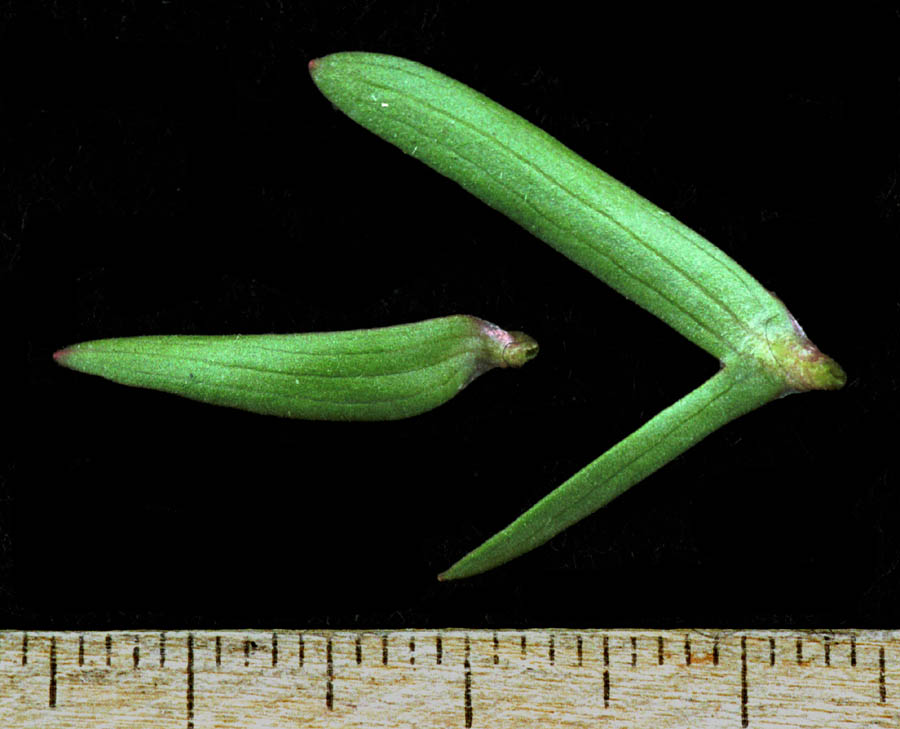
Ranunculus glaberrimus
var. ellipticus

Shiny-leaved Buttercup

Bottom of Cauline Leaf
W. of Crestwynd
04-may-02

Note the absence of pubescence.

Glaberrimus var. ellipticus:  Answers to key questions in Budd's Flora and Flora of Alberta leading to this species and variety.

terrestrial plants; NOT aquatic plants, NOT mud plants

plants mostly with erect stems; plants NOT creeping, plants NOT with stolons, NOT with runners

plants generally less than 1.5 dm tall

plants glabrous or nearly so; NOT hairy

leaves NOT mostly floating, NOT submerged

leaves all, or in part, deeply lobed to compound; leaves NOT [entire or merely toothed]

leaves NOT finely dissected

basal and cauline leaves distinctly unlike, some or all of the basal leaves merely toothed (or entire), most of the cauline leaves deeply cleft and sessile or subsessile; NOT [basal and cauline leaves all deeply incised or divided into distinct segments, the cauline smaller or with fewer segments or with shorter petioles]

basal leaves elliptic to lanceolate, entire; NOT linear-lanceolate to filiform, NOT [ovate to rhomboid, reniform], NOT deeply divided

stem leaves lobed

early flowering

sepals usually 5; NOT 3

sepals lavender tinged on the back

petals longer and wider than the sepals

petals 6-15 mm long; NOT 1.5-3 mm long, NOT 5-9 mm long

petals yellow; NOT [white, sometimes yellowish at base]

achenes in a globose head; NOT in a cylindrical head

achenes glabrous; NOT densely hairy


Ranunculus: Answers to key questions in Budd's Flora and Flora of Alberta leading to this genus. 

plants NOT climbing

both basal and stem leaves usually present; leaves NOT all basal

leaves either basal or alternate; NOT opposite

leaves with segments mostly toothed, acute; leaves NOT [all 3-lobed with lobes entire, rounded]

flowers regular; sepals NOT spurred

petals usually present (yellow or whitish)

carpels 1-ovuled; NOT with several ovules

fruit an achene; NOT a follicle, NOT a dry pod, NOT berry-like


Ranunculaceae: Answers to key questions in Budd's Flora leading to this family.  These answers do not apply to all members of the Ranunculaceae family found in the Canadian prairies, but they do apply to this species.

herbs; NOT shrubs, NOT trees

plants NOT with colored milky juice

plants with more than one normal leaf; leaves NOT used to catch insects, NOT spiny plants with absent or inconspicuous leaves

plants terrestrial or semi-aquatic; NOT with submerged leaves, NOT with floating leaves

some or all leaves alternate

leaves WITHOUT stipules

flowers with two floral rings, and with each petal distinct from the others

calyx regular, all sepals the same size

stamens usually more than 10

carpels separate; NOT united