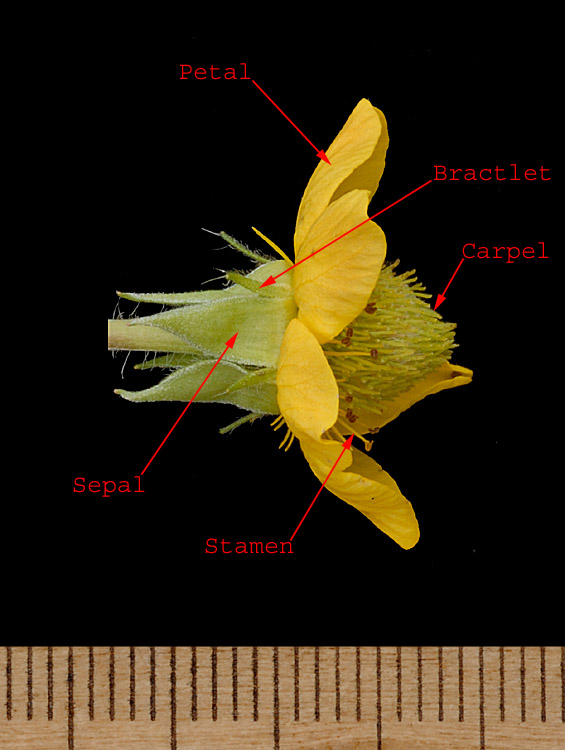
Geum aleppicum
 
Yellow Avens

Flower Side (sepal)

Moose Mountain Provincial Park
10-July-2009

Note that there is a small bractlet in between each pair of sepals.

This species is somewhat similar to G. macrophyllum.  The differences are included in the answers to the keys to the species listed below.  In addition, A Flora Of Northeastern Minnesota states that the sepals are 5-9 mm long in G. aleppicum but are only 2.5-5 mm long in G. macrophyllum.

Aleppicum: Answers to key questions in Budd's Flora and Flora of Alberta leading to this species. 

cauline leaves several; NOT [leaves mostly basal, cauline leaves few (2)]

cauline leaves alternate; NOT [cauline leaves opposite]

leaves lyrately pinnate; NOT [leaves pinnate]

terminal segment of basal leaves cuneate at base; NOT [terminal segment of basal leaves cordate or rounded at base]

terminal segment of basal leaves deeply incised; NOT [terminal segment of basal leaves 3-lobed]

flowers erect; NOT [flowers nodding]

sepals reflexed; NOT [sepals erect or spreading]

sepals 3-8 mm long; NOT [sepals 7-10 mm long]

petals yellow; NOT [petals purplish, flesh-colored, or purple-veined]

style jointed

upper portion of style less than one-third the length of lower part; NOT [upper part of style at least half as long as lower part]

style NOT glandular; NOT [style glandular-pubescent, at least below]

upper portion of style hairy; NOT [upper portion of style not hairy, or with only a few stiff hairs]

style hooked in fruit

style NOT plumose in fruit


Geum: Answers to key questions in Budd's Flora  and Flora of Alberta leading to this genus. 

herbs, or with a woody base and otherwise herbaceous; NOT [shrubs or trees]

leaves compound; NOT [leaves simple, usually toothed], NOT [leaves much dissected into linear lobes]

basal leaves with more than 3 leaflets; NOT [basal leaves with 3 leaflets]

hypanthium LACKING hooked bristles

calyx double, with 2 rings of lobes, the outer ones smaller than the inner; NOT [calyx simple, of 5 lobes]

petals usually longer than the sepals; NOT [petals small, little if any longer than the sepals]

stamens 10-many; NOT [stamens 5]

carpels 10-many; NOT [carpels 2], NOT [carpels 5-20]

style not articulated at base or deciduous but persisting in the fruit; NOT [style articulated at base and deciduous from the achenes]

style much longer than the achene; NOT [style much shorter than the achene]

style often with an abrupt bend or joint near the middle

style hooked or plumose in fruit

carpels becoming achenes (sometimes on a fleshy receptacle); NOT [carpels becoming drupelets (raspberry-like)]


Rosaceae: Answers to key questions in Budd's Flora  leading to this family. 

herbs; NOT [shrubs or trees]

plants terrestrial or semiaquatic; NOT [plants aquatic, leaves submerged or floating]

plants NOT with colored milky juice

flower with more than one normal leaf

some or all leaves alternate; NOT [leaves opposite, whorled, or basal]

leaves with stipules; NOT [leaves without stipules, or having glands]

flowers with two floral rings, and with each petal distinct from the others

calyx regular; NOT [calyx irregular, some sepals smaller than others]

flowers regular in shape; NOT [flowers irregular in shape]

stamens usually numerous; NOT [stamens 5 or 10]

stamens usually separate or partly so, not in  column; NOT [stamens numerous, united into a column]

ovary of one or more carpels, either separate or enclosed by a fleshy receptacle; NOT [ovary of 5 united carpels]