Potentilla paradoxa
 
Bushy Cinquefoil

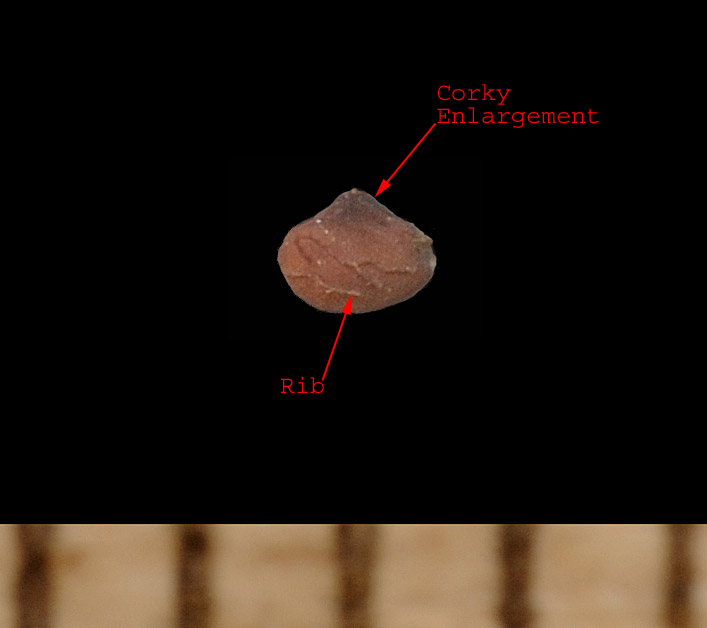
Achene

Valeport, North of Craven on Last Mountain Lake
16-August-2016

Paradoxa: Answers to key questions in Budd's Flora and Flora of Alberta leading to this species. 

plants of drier habitats; NOT [a decumbent plant of aquatic and marshy habitats]

plant herb-like, not woody based;  NOT [plant shrubby or with woody bases]

annual or biennial plant without perennial rootstocks; NOT [perennial plant with stout rootstocks, often showing old bases of leaves]

plant without runners; NOT [low creeping plant with runners]

plants rarely glandular-hairy; NOT [plants glandular-hairy]

basal leaves pinnate; NOT [basal leaves trifoliolate or 5-9 digitate]

stem-leaves several; NOT [stem-leaves 0-2]

stem-leaves pinnate; NOT [stem-leaves subdigitate]

lower stem-leaves with 7-11 leaflets; NOT [lower stem-leaves with 5-7 leaflets], NOT [lower stem-leaves with 3 leaflets]

leaflets sparsely hairy, mostly on veins; NOT [lower surface of leaves densely white tomentose, frequently overlain with sericeous hairs], NOT [leaves densely woolly-hairy below, conspicuously veined above]

leaflets serrate or lobed, generally divided only half-way to midrib or less; NOT [leaflets divided almost to the midrib, or pedately divided or pinnatisect with narrow segments]

leaflets crenately lobed; NOT [leaflets serrate-dentate]

inflorescence many-flowered and leafy

flowers in cymes; NOT [flowers solitary on naked peduncles, mostly from the nodes of stolons]

flowers yellow

petals about equalling sepals; NOT [petals much longer than sepals]

styles arising near top of ovary; NOT [styles nearly basal in origin]

styles tapering from base; NOT [styles slender-fusiform]

achenes ribbed; NOT [achenes smooth]

achenes not hairy

achenes with a corky enlargement on one side


Potentilla: Answers to key questions in Budd's Flora and Flora of Alberta leading to this genus. Not all the answers apply to all members of Potentilla, but all do apply to P. paradoxa.

herbs, or with a woody base and otherwise herbaceous; NOT [shrubs or trees]

leaves compound; NOT [leaves simple], NOT [leaves much dissected into linear lobes]

basal leaves with more than 3 leaflets; NOT [basal leaves with 3 leaflets]

hypanthium lacking hooked prickles; NOT [hypanthium with hooked prickles]

calyx appearing double, with 2 rings of lobes, the outer ones (bractlets of epicalyx) smaller than the inner; NOT [calyx simple, of 5 lobes]

petals usually longer than the sepals; NOT [petals small, little if any longer than the sepals]

stamens 10-many; NOT [stamens 5]

carpels 10-many; NOT [carpels 5-20], NOT [carpels 2]

style much shorter than the achene; NOT [style much longer than the achene]

styles not jointed near the middle; NOT [styles often with an abrupt bend or joint near the middle]

styles not hooked

styles not plumose

styles articulated at base and deciduous from the achenes; NOT [styles not articulated at base or deciduous but persisting in the fruit]

carpels becoming achenes (sometimes on a fleshy receptacle); NOT [fruit fleshy], NOT [carpels becoming drupelets (raspberry-like)]


Rosaceae: Answers to key questions in Budd's Flora  leading to this family. Not all the answers apply to all members of Rosaceae, but all do apply to P. paradoxa.

herbs; NOT [shrubs or trees]

plants terrestrial or semiaquatic; NOT [plants aquatic, leaves submerged or floating]

plants not with colored milky juice

plants with more than one normal leaf

some or all leaves alternate; NOT [leaves opposite, whorled, or basal]

leaves with stipules; NOT [leaves without stipules, or having glands]

flowers regular in shape; NOT [flowers irregular in shape]

flowers with two floral rings

calyx regular; NOT [calyx irregular, some sepals smaller than others]

each petal distinct from the others

stamens usually numerous; NOT [stamens 5 or 10]

stamens usually separate or partly so, not in a column; NOT [stamens numerous, united into a column]

ovary of one or more carpels, either separate or enclosed by a fleshy receptacle; NOT [ovary of 5 united carpels]