| plant herb-like; NOT shrubby, NOT with
woody base |
| perennial plant with stout rootstock,
often showing old bases of leaves; NOT [annual or biennial plant without
perennial rootstocks] |
| plants of drier habitats; NOT [a
decumbent plant of aquatic and marshy habitats] |
| plants WITHOUT runners |
| stems mostly 10-50 cm high; NOT mostly
5-15 cm high |
| plants usually NOT glandular-hairy |
| plants NOT appressed strigose hairy
throughout |
| woolly velutinous to densely sericeous
below; but lacking underlying crinkly hairs; NOT [sericeous below with
underlying or marginal crinkly hairs] |
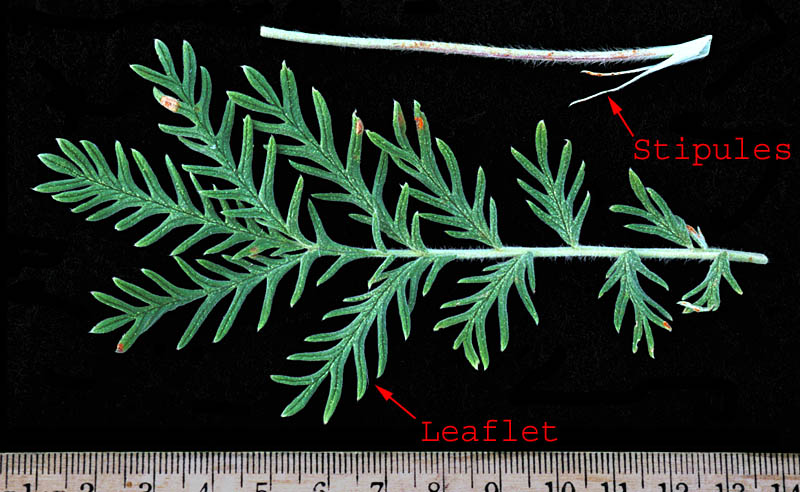
| basal leaves pinnate; NOT [trifoliate
or 5-9-digitate] |
| leaflets separate, the leaves
distinctly pinnate; NOT [leaflets often approximate, the leaves
appearing subdigitate] |
| basal leaves generally with 5-9
leaflets; NOT [generally with 9-21 leaflets] |
| leaflets white or a different shade of
green below; NOT green on both sides (Budd's Flora) |
| leaves with abundant appressed to
spreading sericeous hairs on lower surface; leaves NOT [green above and
below] (Flora of Alberta) |
| leaves densely woolly-hairy below,
conspicuously veined above; NOT [leaflets sparsely hairy, mostly on
veins] (Flora of Alberta) |
| lower surface of leaves NOT densely
white tomentose, NOT [tomentose and overlain with sericeous hairs]
(Flora of Alberta) |
| leaves grayish pilose to hirsute below;
NOT white tomentose below (Budd's Flora) |
| leaflets pale green or grayish pilose
to glandular below; NOT white tomentose below (Budd's Flora) |
| flowers few-many, in terminal cymes;
NOT [solitary on naked peduncles, mostly from nodes of stolons] |
| bractlets about as long as sepals; NOT
much longer than sepals |
| bractlets mostly narrower than sepals;
NOT [as wide as or wider than sepals] |
| petals yellow; NOT white, NOT yellowish
white, NOT reddish purple |
| petals generally longer than sepals;
NOT [as long as or slightly shorter than the sepals] |
| petals somewhat longer than sepals; NOT
much longer than sepals |
| petals 4-6 mm long; NOT 3-5 mm long |
| stamens 5-20; NOT 25-30 |
| styles arising near top of ovary;
styles NOT nearly basal in origin |
| styles tapered from base; styles NOT
slender-fusiform |
| achenes generally smooth; NOT hairy |