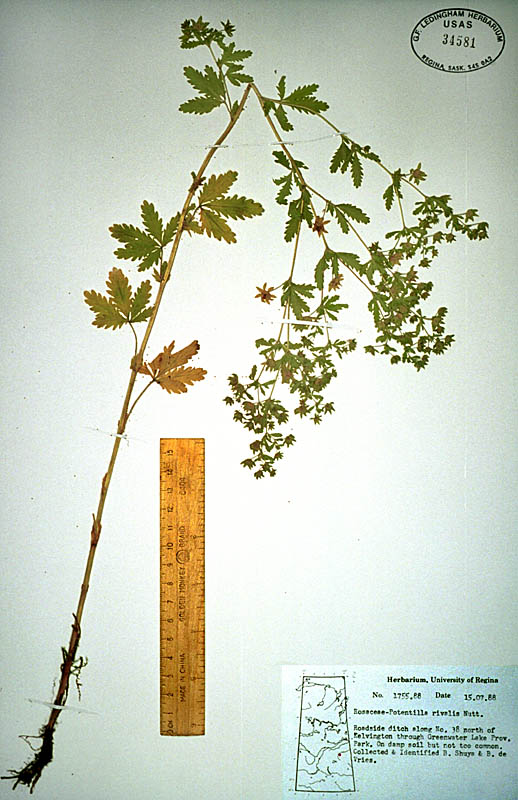
Potentilla rivalis


Brook Cinquefoil

G. F. Ledingham Herbarium
University of Regina

The lower leaves in this species are somewhat variable, and their treatment in the keys somewhat confusing.  The statement "lower leaves ternate or digitately 5-7 foliate, sometimes pinnate" captures all the variations.


Rivalis:  Answers to key questions in Budd's Flora and Flora of Alberta leading to this species.  

herbs

plants not usually glandular

plants without runners

lower leaves ternate or digitately 5-7 foliate, sometimes pinnate

leaflets green below, often hirsute or pilose; NOT densely white or gray tomentose

flowers few to many, in terminal cymes; NOT solitary on naked peduncles; NOT from nodes of stolons

flowers in a leafy cyme; inflorescence NOT just leafy at base

petals yellow

petals shorter than sepals; NOT longer than sepals

petals minute; NOT large

petals cuneate or narrowly obovate; NOT broadly obovate or rounded

stamens 5 or 10

style terminal to the ovary or nearly so; NOT nearly basal

achenes smooth; NOT somewhat rugulose ribbed; NOT with a corky enlargement on one side

The key to the Rosaceae genera in Flora of Alberta requires that the petals of Potentilla be longer than the sepals; however, they are shorter than the sepals in this species.  Similarly, the same key requires 10 or more stamens, while the key to the Potentilla species in the same flora allows rivalis to have 5 stamens.


Potentilla: Answers to key questions in Budd's Flora and Flora of Alberta leading to this genus.  These answers do not apply to all species of Potentilla found in the Canadian prairie provinces, but they do apply to this species.

herbs, or with a woody base but otherwise herbaceous; NOT shrubs or trees

leaves compound, but NOT much dissected into linear lobes

basal leaves with more than 3 leaflets

calyx lobes 5, alternating with smaller bractlets, together appearing like 10 sepals

hypanthium lacking hooked prickles

petals usually longer than the sepals; NOT little if any longer than the sepals (FOA)

stamens 10 or more; NOT 5 (FOA)

carpels 10-many

style much shorter than the achene

style articulated at base and deciduous from the achene; NOT jointed near the middle; NOT plumose; NOT persisting in fruit

carpels becoming achenes, but NOT in a fleshy receptacle (eg. strawberry); carpels NOT becoming druplets (eg. raspberry)


Rosaceae: Answers to key questions in Budd's Flora leading to this family.

herbs

plants terrestrial or semi-aquatic

plants NOT with colored milky juice

plants with more than one normal leaf

some or all leaves alternate

leaves with stipules

flowers with two floral rings, and with each petal distinct from the others

calyx regular

flowers regular in shape

stamens usually separate or partly so; NOT united in a column

stamens usually numerous; NOT 5 or 10

ovary of one or more carpels; NOT of 5 united carpels