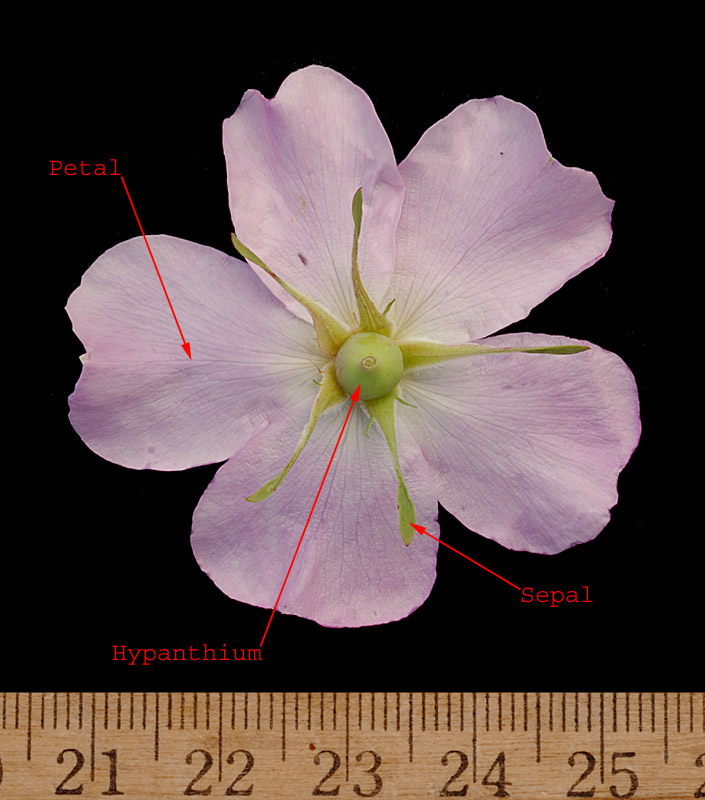
Wood's Rose
Rosa woodsii
Wood's Rose
Flower Bottom
Oro Lake Regional Park
30-June-2011
Rosa woodsii and Rosa acicularis are sometimes difficult to distinguish, and in addition they occasionally hybridize. The following table contains characteristics for each of these species taken from a number of flora (listed at the bottom of the table). The entry for the first row, taken from Plants of the Western Boreal Forest & Aspen Parkland (PWB), is probably the most reliable way to distinguish between the species. Note that the difference applies just to the upper or current year's stems. Lower stems of both species are well armed.
| Rosa acicularis | Rosa woodsii |
| Upper stems usually densely covered with many straight, weak bristles and straight, slender thorns (PWB) | Upper stems lack many small bristles and prickles, instead have a few scattered thorns, usually at stem nodes (PWB) |
| Stems bristly to tips (FOA1) | Stems with scattered bristles or bristly at base only (FOA1) |
|
Stem and branches very bristly (FOC) |
Stem less bristly, the bristles scarcely (if at all) extending into the branches (FOC) |
| Stem-prickles uniformly dense throughout (FOA2) | |
|
Stems and branches densely covered with bristles and with straight terete prickles (FYT) |
Stems less densely armed and branches often bearing only infrastipular prickles (FYT) |
|
Thorns not present (BF) |
Thorns present below the stipules (BF) |
|
Thorns directly below the stipules none or not different from the internodal ones (FOA1) |
Thorns commonly present at the base of the stipules (FOA1) |
| Infrastipular prickles absent (FOA2) | Infrastipular prickles present, conspicuously larger and stouter than the stem-prickles (FOA2) |
|
Stems without infrastipular prickles or these not differentiated from those of the internodes. (FGP) |
Stems usually with well-defined infrastipular prickles. (FGP) |
|
Infrastipular prickles not clearly differentiated from those of the internodes (FOC) |
|
|
Bristles usually not broad or flattened at the base (BF) |
Bristles broad and usually flattened at the base (BF) |
| Stipules densely glandular (FOA2) | Stipules sparsely glandular (FOA2) |
|
The leaf-rachis usually glandular (FOC) |
|
|
Leaflets commonly 5-7 (FOA1) |
Leaflets usually 5-9 (FOA1) |
| Leaflets 3-7, commonly 5, rarely 9 (FOA2) | Leaflets 5-7 in some plants, 7-9 in others (FOA2) |
|
Leaflets oblong-elliptic, often 3-4 cm long, irregularly dentate-serrate, the teeth acute (FOA1) |
Leaflets oval to obovate, mostly 1-3 cm long, regularly serrate, the teeth often acuminate (FOA1) |
| Leaflet base obtuse or rounded (FOA2) | Leaflet base acute (FOA2) |
| Leaflets generally more than 25 mm long (FOA2) | Leaflets generally less than 25 mm long (FOA2) |
|
Leaflets often resinous-puberulent beneath (FOC) |
|
|
Flowers solitary (rarely 2) on lateral branches of the season (FOC) |
Flowers mostly in corymbiform cymes terminating the lateral branches of the season (FOC) |
|
|
Petals to 2.5 cm long (FOC) |
|
Sepals ascending at maturity, beak-like at the summit of the fruit (FOC) |
Sepals to about 1.5 cm long, glabrous to puberulent or occasionally inconspicuously glandular (rarely coarsely stipitate-glandular) (FOC) |
|
Fruit oval with distinct neck (BF) |
Fruit globose without constricted neck (BF) |
| Fruit globose (lacking a neck) to pear-shaped, with a distinct neck below (FOA2) | Fruit globose, lacking a neck below (FOA2) |
|
Rosehip round to pear-shaped with a distinct stalk or ?neck? below (WOP) |
Fruits are spherical but lack a neck (WOP) |
BF ? Budd?s Flora
FGP ? Flora of the
Great Plains
FOA1 ? Flora of Alberta, First Edition FOA2 - Flora
of Alberta, Second Edition
FOC ? Flora of Canada
FYT ? Flora of
the Yukon Territory
PWB - Plants of the Western Boreal Forest & Aspen Parkland
WOP ? Weeds of the
Prairies
 | Woodsii: Answers to key questions in Budd's Flora (BF) and Flora of Alberta (FOA) leading to this species.
| ||||||||||||||||||||||||||||||||
| Rosa: Answers to key questions in Budd's Flora and Flora of Alberta leading to this genus.
|
| Rosaceae: Answers to key questions in Budd's Flora leading to this family. Not all the answers apply to all members of Rosaceae found on the Canadian prairies, but they all do apply to this species.
|
