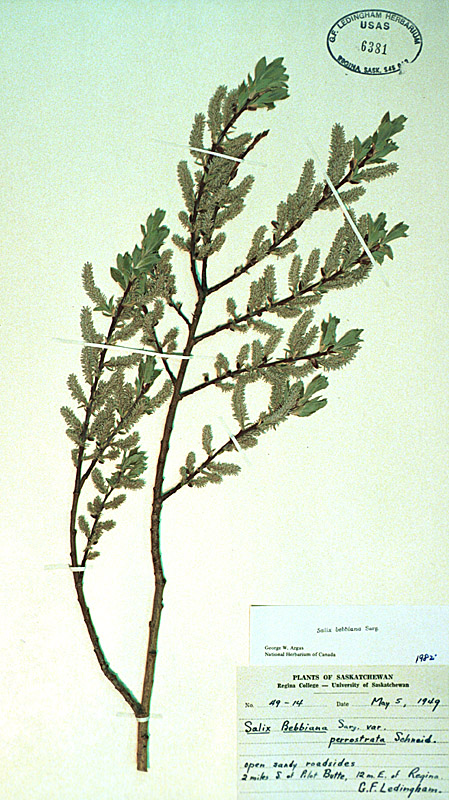
|
Bebbiana: Answers
to key questions in Conifers & Catkin-Bearing Trees and Shrubs of
Saskatchewan, Fascicle 5, Flora of Saskatchewan by Anna Leighton leading
to this species. The answers are in the order you would normally work
through the key.
 |
Catkins usually flowering as leaves
emerge, sometimes just before leaves emerge or throughout the season,
subtended by small green leaves of the flowering branchlet that supports
them. NOT [Catkins usually flowering before leaves emerge,
borne directly on bare branches (sessile) and subtended by 1 - 3 short,
greenish or brownish, caducous bract-like leaves] |
|
Low to tall shrubs or trees; not confined
to subarctic regions. NOT [Dwarf shrubs <= 0.15 m (15 cm) tall;
subarctic regions] |
|
Shrubs, usually with several stems;
ovaries glabrous or hairy. NOT [Trees, with a single
trunk, or with several trunks of tree stature; ovaries glabrous] |
|
NOT [Plants flowering as leaves emerge or
throughout the season, often bearing branched catkins; leaf blades
linear or strap-shaped, 9 ? 14 ? 24 times longer than wide, up to 11
mm wide with margins remotely spinulose-serrulate, the teeth widely
spaced; hairs on leaves white, ferruginous hairs lacking; plants forming
extensive colonies by root shoots] |
|
Petioles without glandular dots or lobes
at distal end, or with occasional, inconspicuous dots; floral bracts not
as above, if conspicuous and pale, then not deciduous. NOT
[Petioles with glandular dots or lobes at distal end; floral bracts pale
tawny, 1.2 ? 4 mm, conspicuous during flowering, deciduous after
flowering] |
|
Ovaries hairy. NOT [Ovaries
glabrous] |
|
Ovaries sparsely short-silky; stipes long
(1.4 ? 6 mm); styles short (0 ? 0.5 mm. NOT [Ovaries without the
above combination of characteristics ? if appearing sparsely
short-silky, then stipes shorter than 1.4 mm or styles longer than 0.5
mm] |
|
Stipes 2 ? 6 mm; floral bracts 1 ? 3
mm, tawny; catkins 16 ? 80 mm, stout, slender or subglobose; flowering
branchlets 1 ? 26 mm; leaf blades narrowly oblong, narrowly elliptic,
elliptic, oblanceolate or obovate, 2 ? 3 ? 4 times longer than wide;
leaf blade veins protruding on lower surface; ferruginous hairs absent
on leaf blades and ovaries. NOT [Stipes 1.4 - 4 mm; floral bracts
1 ? 2 mm, brown, tawny, light rose or bicolor; catkins 12 - 39 mm,
stout to globose; flowering branchlets 1 ? 11 mm; leaf blades
strap-shaped to very narrowly elliptic, 5 ? 7 ? 9 times longer than
wide; leaf blade veins flat on lower surface; ferruginous hairs may be
present on leaf blades and ovaries]
|
|
|
Salix: Answers
to key questions in Conifers & Catkin-Bearing Trees and Shrubs of
Saskatchewan, Fascicle 5, Flora of Saskatchewan by Anna Leighton leading
to this genus.
|
shrubs or trees; NOT [trees] |
|
buds covered by 1 scale; NOT [buds
covered by 3-10 scales] |
|
buds scale not resinous; NOT [bud scale
usually resinous] |
|
catkins sessile or terminating flowering
branchlets; NOT [catkins sessile] |
|
catkins erect, spreading, or +/-
pendulous; NOT [catkins pendulous] |
|
floral bracts entire, erose, bifid, or
irregularly toothed; NOT [floral bracts deeply cut] |
|
perianth reduced to an adaxial nectary
(rarely also an abaxial nectary, then the 2 nectaries distinct or
connate into a shallow cup); NOT [perianth reduced to a
non-nectariferous, cup-shaped or shallow saucer-shaped floral disc] |
|
stamens 1, 2, or 3 ? 10; NOT [stamens 6
? 60 (70)] |
|
capsules obclavate to ovoid or ellipsoid;
NOT [capsules narrowly ovoid to spherical, with the floral disc
persistent at base] |
|
capsules 2-valved; NOT [capsules 2 - 4
valved] |
|