Salix scouleriana
 
Scouler's Willow

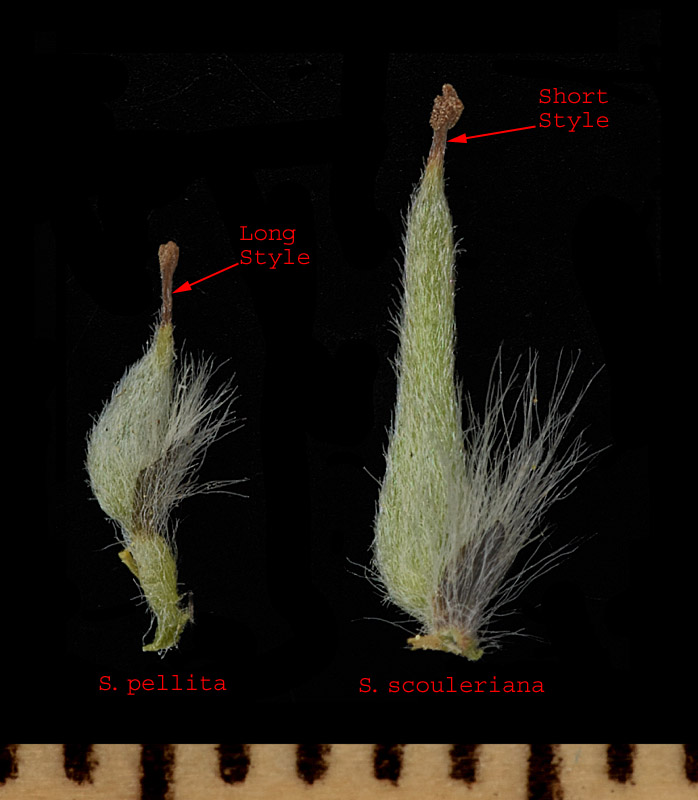
S. scouleriana - S. pellita Pistillate Flower Comparison

Brockelbank Hill, Highway 980 South of Armit
22-May-2018

Note the short style on S. scouleriana and the long style on S. pellita.

Scouleriana: Answers to key questions in Conifers & Catkin-Bearing Trees and Shrubs of Saskatchewan, Fascicle 5, Flora of Saskatchewan by Anna Leighton leading to this species. The answers are in the order you would normally work through the key

Catkins usually flowering before leaves emerge, borne directly on bare branches (sessile) and subtended by 1 - 3 short, greenish or brownish, caducous bract-like leaves. NOT [Catkins usually flowering as leaves emerge, sometimes just before leaves emerge or throughout the season, subtended by small green leaves of the flowering branchlet that supports them.]

Ovaries hairy.  NOT [Ovaries glabrous.]

Ovaries short- or long-silky; stipes 0.2 ? 2.7 mm; plants less hairy; not restricted to the south shore of Lake Athabasca.  NOT [Ovaries villous; stipes 0 - 0.3 mm; plants densely hairy; south shore of Lake Athabasca.]

Stipes long (0.8 ? 2.7 mm), styles short (0.2 ? 1 mm); capsules 4.5 ? 11 mm.  NOT [Stipes short (0.2 ? 1.1 mm), styles long (0.5 ? 2 mm); capsules 3 ? 7 mm.]

Ovaries very densely long-silky; floral bracts 1.5 ? 4.5 mm, rounded or acute at tip; styles 0.2 ? 0.6 mm; emerging leaves with lower surfaces usually uniformly very densely hairy and blades often wider at tip than at base; branches flexible to highly brittle at base; primarily boreal forest and Cypress Hills.  NOT [Ovaries moderately densely short-silky; floral bracts 1 ? 3 mm, acute or convex at tip; styles 0.3 ? 1 mm; emerging leaves with lower surfaces sparsely hairy and blades usually widest in the middle; branches flexible at base; throughout SK but less common northward.]


Salix: Answers to key questions in Conifers & Catkin-Bearing Trees and Shrubs of Saskatchewan, Fascicle 5, Flora of Saskatchewan by Anna Leighton leading to this genus

shrubs or trees; NOT [trees]

buds covered by 1 scale; NOT  [buds covered by 3-10 scales]

buds scale not resinous; NOT [bud scale usually resinous]

catkins sessile or terminating flowering branchlets; NOT [catkins sessile]

catkins erect, spreading, or +/- pendulous; NOT [catkins pendulous]

floral bracts entire, erose, bifid, or irregularly toothed; NOT [floral bracts deeply cut]

perianth reduced to an adaxial nectary (rarely also an abaxial nectary, then the 2 nectaries distinct or connate into a shallow cup); NOT [perianth reduced to a non-nectariferous, cup-shaped or shallow saucer-shaped floral disc]

stamens 1, 2, or 3 ? 10; NOT [stamens 6 ? 60 (70)]

capsules obclavate to ovoid or ellipsoid; NOT [capsules narrowly ovoid to spherical, with the floral disc persistent at base]

capsules 2-valved; NOT [capsules 2 - 4 valved]


Salicaceae: Answers to key questions in Budd's Flora  leading to this family. 

shrubs or trees; NOT [herbs]

flowers with only one floral ring, with sepals but not petals

male flowers, at least, in catkins or aments; NOT [flowers not in catkins or aments]

seeds each with a tuft of hairs; NOT [seeds without a tuft of hairs]