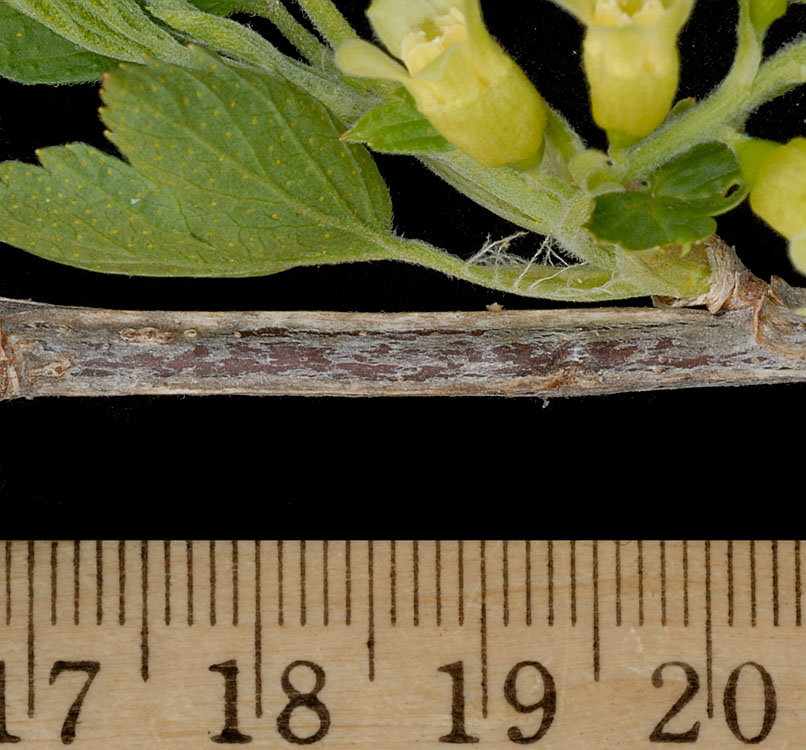
Ribes americanum

Wild Black Currant

Upper Stem

Good Spirit Lake Provincial Park
31-May-2008

The Ribes genus was previously placed within a traditional version of the Saxifragaceae family which included a great many diverse genera.  That version of the Saxifragaceae family is now considered to be polyphyletic, and the family is now much reduced.  Ribes has been moved to a new family called Grossulariaceae, within which Ribes is the only genus.  Budd's Flora (1987) still places Ribes in Saxifragaceae, while Flora of Alberta (1994) places it in Grossulariaceae.

Americanum: Answers to key questions in Budd's Flora (BF)  and Flora of Alberta (FOA) leading to this species. 
stems not spiny, or spines only at the nodes; NOT [stems densely spiny along the internodes] (BF)
stems not prickly; NOT [stems more or less prickly] (FOA)
stems not bristly; NOT [stems usually bristly] (FOA)
leaves plicate (folded) in the bud; NOT [leaves convolute (rolled) in the bud]
NOT [plants with leaves, young stems, inflorescence and fruits all glandular-puberulent]
leaves dotted beneath with resinous glands or bearing stalked glands; NOT [leaves without resinous glands]
inflorescence an elongated raceme, flowers numerous; NOT [inflorescence a reduced raceme, 1- to 3- flowered]
pedicels much shorter than the bracts; NOT [pedicels much longer than the bracts]
pedicels jointed below the ovary
flowers regular; NOT [flowers slightly irregular]
hypanthium-tube tubular to narrowly cup-shaped; NOT [hypanthium-tube broadly cup-shaped]
flowers not golden yellow; NOT [flowers golden yellow to somewhat reddish]
sepals greenish white or yellowish; NOT [sepals white]
ovary lacking sessile glands; NOT [ovary usually with a few sessile glands]
ovary and fruit glabrous; NOT [ovary and fruit more or less densely glandular pubescent]
fruits black when mature; NOT [fruits reddish or blue-black when mature]


Grossulariaceae: Answers to key questions in Flora of Alberta leading to this family.  Note these answers only apply to the unarmed members of the family.
shrubs; NOT [herbs]
plants NOT aquatic
plants green; NOT [plants white, pink or reddish brown]
plants unarmed; NOT [plants armed with prickles, spines or thorns]
leaves alternate; NOT [leaves opposite or whorled]
leaves well developed; NOT [leaves reduced to scales]
leaves not needle-like; NOT [leaves needle-like 5-10 mm long]
perianth biseriate (i.e. of two different series of appendages, the inner generally larger, coloured, the outer generally smaller, greenish); NOT [perianth uniseriate (i.e. of only one series of appendages all more or less the same) or entirely absent]
corolla of separate petals; NOT [corolla of united petals, or only 2 or 3 petals connate or united and the flowers markedly irregular] (Note: the bases of the sepals, petals, and stamens of Grossulariaceae are fused to create a hypanthium which arises from the top of the inferior ovary.  Above the hypanthium the petals are distinct.)
stamens alternate with the petals; NOT [stamens opposite the petals]
stamens 5
ovary inferior; NOT [ovary superior]
fruit yellow, red or black; NOT [fruit white or orange-red]
fruit several-seeded; NOT [fruit 1-seeded]
NOT [plants 1-2 dm tall, with small appressed leaves; pubescent; flowers yellow; of sandy habitats]