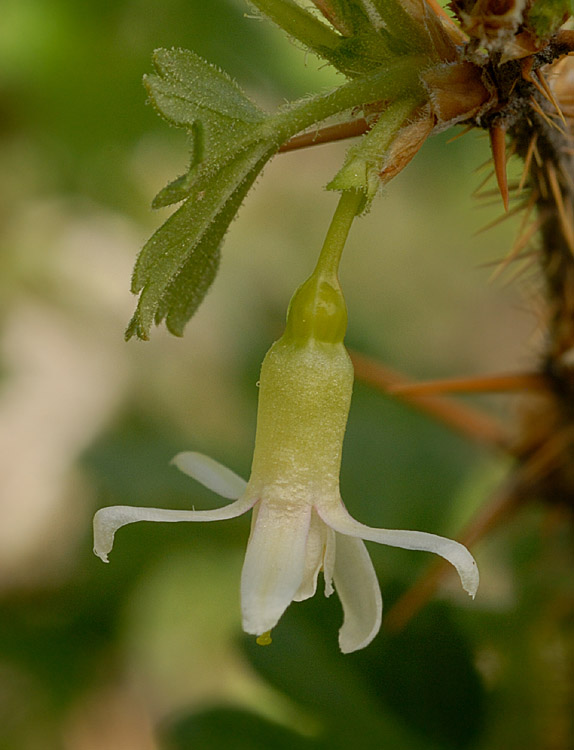
Ribes oxyacanthoides

Northern Gooseberry

Flower Side in Ground

Redberry Lake Regional Park
17-May-08

Note the spreading sepals arising from the edge of the cylindrical hypanthium.  The sepals often reflex as the flower develops.  Note also the inferior ovary.

The Ribes genus was previously placed within a traditional version of the Saxifragaceae family which included a great many diverse genera.  That version of the Saxifragaceae family is now considered to be polyphyletic, and the family is now much reduced.  Ribes has been moved to a new family called Grossulariaceae, within which Ribes is the only genus.  Budd's Flora (1987) still places Ribes in Saxifragaceae, while Flora of Alberta (1994) places it in Grossulariaceae.  

Oxyacanthoides: Answers to key questions in Budd's Flora (BF)  and Flora of Alberta (FOA) leading to this species. 
stems more or less prickly; NOT [stems not prickly]
stems usually bristly; NOT [stems not bristly]
fruiting stems usually bristly; NOT [fruiting stems rarely with bristles on the middle and upper internodes]
inflorescence a reduced raceme, 1- to 3- flowered; NOT [inflorescence an elongated raceme, flowers numerous]
pedicels NOT jointed below the ovary
calyx tubular to cup-shaped; NOT [calyx saucer-shaped]
stamens shorter than the sepals; NOT [stamens about equalling the sepals]
stamens about as long as the petals; NOT [stamens longer than the petals]
fruit smooth; NOT [berries bristly glandular]
fruit red to black; NOT [berries black]


Grossulariaceae: Answers to key questions in Flora of Alberta leading to this family.  Note these answers only apply to the armed members of the family.
plants NOT aquatic
plants green; NOT [plants white, pink or reddish brown]
shrubs; NOT [herbs]
plants armed with prickles, spines or thorns; NOT [plants unarmed]
leaves or branches armed, not both; NOT [leaves and branches both armed]
branches with needle-like spines; NOT [branches with stout thorns (1) 2-7 cm long]
leaves alternate; NOT [leaves opposite], NOT [leaves whorled]
leaves well developed; NOT [leaves reduced to scales]
leaves NOT pinnate
leaves NOT spiny-margined
perianth biseriate (i.e. of two different series of appendages, the inner generally larger, coloured, the outer generally smaller, greenish); NOT [perianth uniseriate (i.e. of only one series of appendages all more or less the same) or entirely absent]
corolla of separate petals; NOT [corolla of united petals, or only 2 or 3 petals connate or united and the flowers markedly irregular] (Note: the bases of the sepals, petals, and stamens of Grossulariaceae are fused to create a hypanthium which arises from the top of the inferior ovary.  Above the hypanthium the petals are distinct.)
stamens 5; NOT [stamens 10], NOT [stamens more than twice as many as the petals, usually numerous]