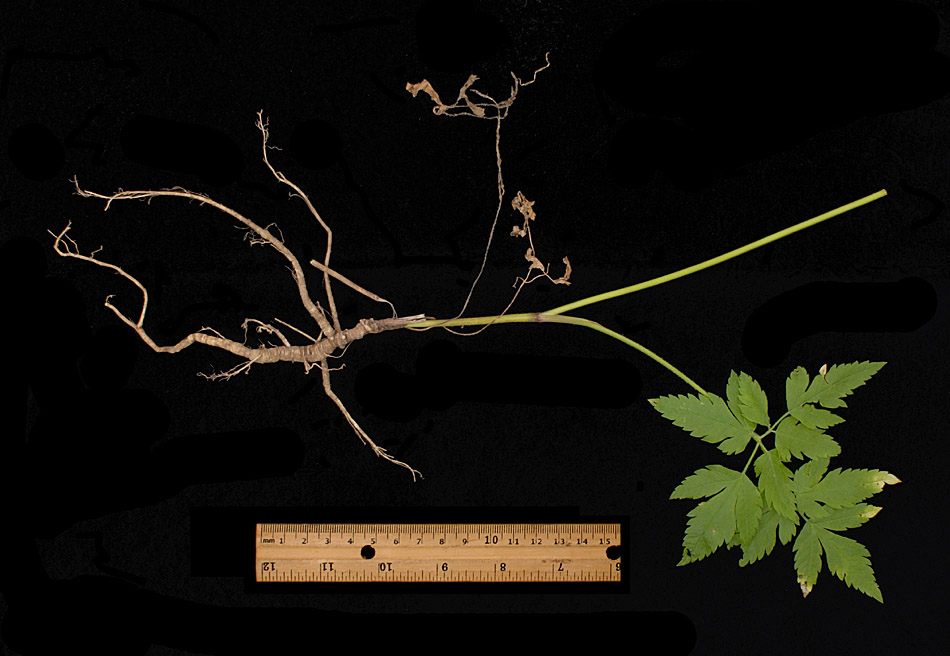
Osmorhiza berteroi
 
Blunt-Fruited Sweet Cicely

Lower Plant

Centre Block, Cypress Hills Interprovincial Park
16-July-2014

The literature regarding Osmorhiza is confusing.  I believe Budd's Flora identifies this species as O. chilensis var. chilensis, while I believe Flora of Alberta calls it O. chilensis.  In the answers to the key to the species below, I have eliminated answers which I find contradictory or confusing.  I believe the best way to distinguish the species of Osmorhiza found in Saskatchewan is by looking at the fruit.

Berteroi: Answers to key questions in Budd's Flora and Flora of Alberta leading to this species. 

rays and pedicels usually ascending; NOT [rays and pedicels wide-spreading or reflexed]

bracts and bractlets of inflorescence absent or very small and caducous; NOT [bracts and bractlets of inflorescence present and persistent]

flowers white or greenish; NOT [flowers yellow, pale yellow, or purple]

stylopodium longer than broad; NOT [stylopodium broader than long]

styles less than 0.5 mm long; NOT [styles 2-3 mm long]

fruits longer than the pedicels

fruit 12-22 mm long; NOT [fruit 8-13 mm long]

fruit cylindrical, the apex concavely narrowed (constricted) into a beak 0.5-2.0 mm long; NOT [fruit clavate, the apex convexly narrowed]

base of fruit long-tapering, becoming caudate with conspicuous tails; NOT [fruit obtuse at base]

fruit bristly-hispid; NOT [fruit glabrous]


Osmorhiza: Answers to key questions in Budd's Flora  and Flora of Alberta leading to this genus. 

NOT [plants with a bluish tinge, flowers in dense globose heads, bracts spiny]

plants lacking axillary bulblets; NOT [plants with axillary bulblets largely replacing flowers]

foliage NOT digitately compound (BF)

foliage NOT spiny (BF)

lower and upper leaves compound; NOT [lowest leaves simple] (FOA)

leaves divided into few well-developed leaflets; NOT [leaves much divided, with leaflets or segments numerous] (BF)

leaves ternately divided; NOT [leaves pinnately divided] (BF)

leaves with more than 3 leaflets; NOT [leaves with 3 leaflets] (BF)

leaves divided into leaflets of unequal size, often with 5 or more segments; NOT [leaves divided into leaflets of about equal size, usually 3 segments each with 3 leaflets] (BF)

NOT [leaves usually trifoliolate, leaflets palmate, leaflets 10-30 cm wide]

NOT [leaves palmate with 5-7 large leaflets]

leaflets finely to deeply serrate; NOT [leaflets entire or with a few lobes] (BF)

inflorescence NOT bluish

fruit more than 1 cm long

fruit several times longer than broad; NOT [fruit generally 3 times as long as broad or less]

fruit linear to clavate; NOT [fruit oblong to elliptical]

fruit flattened but wingless; NOT [fruit strongly flattened, broadly winged]

fruit usually bristly-hairy; NOT [fruit glabrous]

fruit NOT covered with short, hooked spines


Umbelliferae: Answers to key questions in Budd's Flora  leading to this family. 

herbs; NOT [shrubs or trees]

plants terrestrial or semiaquatic; NOT [plants aquatic, leaves submerged or floating]

plants NOT with colored milky juice

stems hollow

plants with more than one normal leaf

some or all leaves alternate; NOT [leaves opposite, whorled, or basal]

leaves without stipules, or having glands; NOT [leaves with stipules]

flowers in umbels

parts of flowers mostly in fives; NOT [parts of flowers in twos or fours]

flowers with two floral rings, and with each petal distinct from the others

calyx regular; NOT [calyx irregular, some sepals smaller than others]

stamens 10 or fewer; NOT [stamens usually more than 10]

ovary inferior

styles 2; NOT [styles 5]